 English
 Bahasa Melayu


Recent Articles
View All
The Original Shahadah in the Time of the Messenger of Allah SAW
What wording of the Shahadah did the Messenger of Allah SAW teach? The Hadith of Jibril in Sahih Muslim 8a and the post-wudu narration in Sahih Muslim 234a preserve two authentic wordings that must be understood in their proper contexts. Their difference is not a contradiction but a reason to examine the Prophet’s teaching with greater care.
Where Do the Prophets Fit in the Theory of Malay Origins?
Theories of Malay origins trace language, migration and population mixing. Yet one basic question is often left aside: where do the prophets fit into the histories of these communities? The question also challenges how readily human theories are accepted while possibilities raised by the Qur’an are dismissed.
Islam Is Universal, Yet Why Does It Seem Like an Arab Religion?
Islam was revealed in Arabic and Prophet Muhammad was an Arab. Does that make Islam the faith of one people? This essay explores the question through the Qur’anic account of earlier prophets.
Is the Malay Word Related to the Expression al-Mala’i from Bani Israel?
The Qur’an does not mention “Melayu” in its modern spelling, yet Surah al-Baqarah 2:246 contains the expression al-Mala’i from Bani Israel. Could this sound resemblance preserve a trace of forgotten history, or is it the starting point of a hypothesis that still needs to be proven?
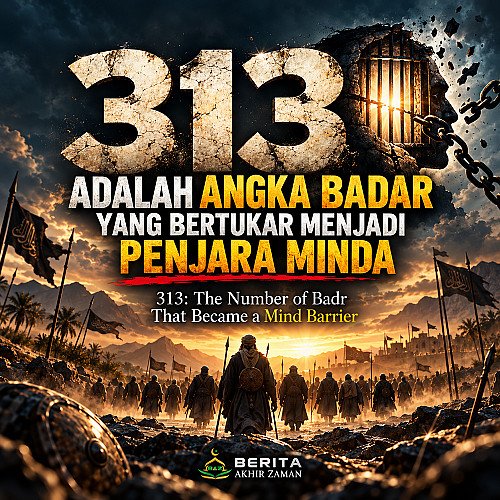
313: The Number of Badr That Became a Mind Barrier
The number 313 is frequently associated with Imam Mahdi, chosen groups and end-times fighters. But how firmly does that association actually stand on textual evidence? When a historical number from Badr becomes a group identity, it can turn into a mind barrier that makes some people feel chosen while others feel they have no place at all.
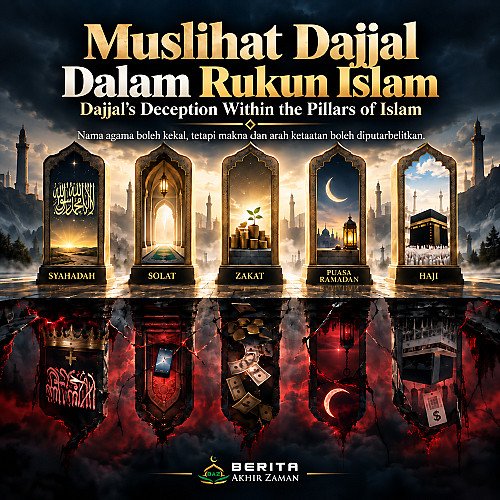
Dajjal’s Deception Within the Pillars of Islam
What if the Pillars of Islam are not abolished but their names and outward forms remain while their meanings are changed? This article examines Dajjal’s deception through syahadah, solat, zakat, fasting and haji and how obedience to Allah can gradually be redirected towards a human being.