 English
 Bahasa Melayu


Articles
The Original Shahadah in the Time of the Messenger of Allah SAW
What wording of the Shahadah did the Messenger of Allah SAW teach? The Hadith of Jibril in Sahih Muslim 8a and the post-wudu narration in Sahih Muslim 234a preserve two authentic wordings that must be understood in their proper contexts. Their difference is not a contradiction but a reason to examine the Prophet’s teaching with greater care.
Where Do the Prophets Fit in the Theory of Malay Origins?
Theories of Malay origins trace language, migration and population mixing. Yet one basic question is often left aside: where do the prophets fit into the histories of these communities? The question also challenges how readily human theories are accepted while possibilities raised by the Qur’an are dismissed.
Islam Is Universal, Yet Why Does It Seem Like an Arab Religion?
Islam was revealed in Arabic and Prophet Muhammad was an Arab. Does that make Islam the faith of one people? This essay explores the question through the Qur’anic account of earlier prophets.
Is the Malay Word Related to the Expression al-Mala’i from Bani Israel?
The Qur’an does not mention “Melayu” in its modern spelling, yet Surah al-Baqarah 2:246 contains the expression al-Mala’i from Bani Israel. Could this sound resemblance preserve a trace of forgotten history, or is it the starting point of a hypothesis that still needs to be proven?
313: The Number of Badr That Became a Mind Barrier
The number 313 is frequently associated with Imam Mahdi, chosen groups and end-times fighters. But how firmly does that association actually stand on textual evidence? When a historical number from Badr becomes a group identity, it can turn into a mind barrier that makes some people feel chosen while others feel they have no place at all.
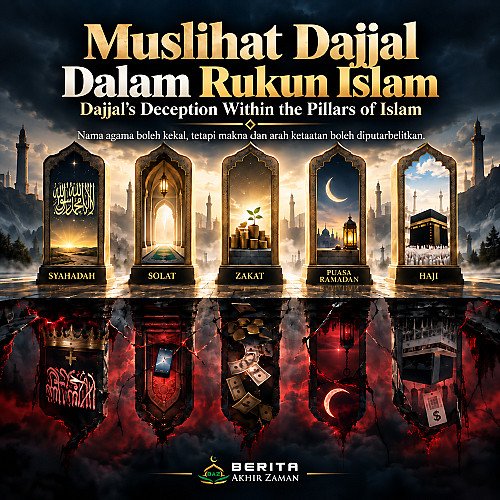
Dajjal’s Deception Within the Pillars of Islam
What if the Pillars of Islam are not abolished but their names and outward forms remain while their meanings are changed? This article examines Dajjal’s deception through syahadah, solat, zakat, fasting and haji and how obedience to Allah can gradually be redirected towards a human being.
Qalbun Salim Is a Forerunner to Jannah
Qalbun Salim is often understood as a pure heart yet its formation requires more than knowledge and dhikr. The Qur’anic account of Prophet Ibrahim reveals how deeds, obedience and righteousness shape a safe heart and lead a servant towards al-Muqarrabun and Jannah.
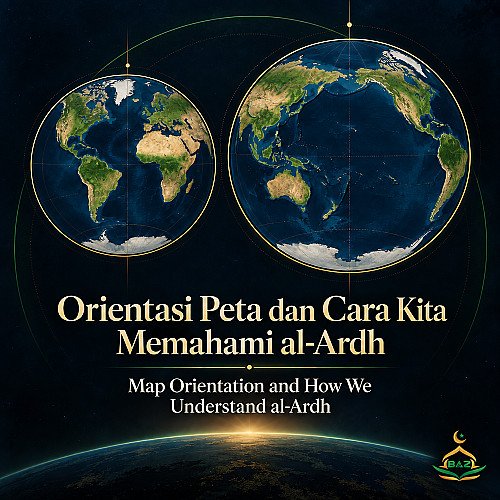
Map Orientation and How We Understand al-Ardh
We often take the image of Earth in our minds for granted. Yet that image may shape how we read the Qur’an and understand the history of the prophets. What might change if the familiar orientation of the map were different?
Lost Tribes or The Left Tribes? Who Decides Who the “Lost Tribes” of Bani Israel Are?
Who decides which Bani Israel groups are remembered and which are labelled “lost”? This article challenges the Jerusalem-centered narrative and invites readers to reconsider the Lost Tribes through the mashriq and Nusantara.
Do the Bani Israel Still Exist, or Does Only Their Name Remain?
Have the Bani Israel disappeared from the world with only the Yahudi in the illegal State of Israel remaining? This question must be reconsidered through the Qur’an’s language concerning lineage, tribes and gathering. The study reopens the question of the Lost Tribes and Left Tribes through linguistic evidence and the Qur’an bil Qur’an approach.
Ahlul Kisa' Series
Many people know the names of the five individuals in the event of Ahlul Kisa', yet those names are only the beginning of a larger set of questions. The three parts guide readers through the hadith, Ummu Salamah's home and the space beneath the Kisa' before examining their connection to the purification of Ahlul Bait, Tsaqalain and Imam Mahdi. Read separately, the overall structure and meaning of the event may not be seen clearly.
Human Beings Do Not Create Their Own Ta’wil but Can Only Seek the Ta’wil Established by Allah
When facing a mutasyabih verse, should human beings seek the meaning Allah established or impose a meaning of their own upon revelation? Through Surah Ali ‘Imran 3:7 and relevant hadith this article examines the difference between seeking ta’wil and creating ta’wil. It also explains the role of tafsir al-Qur’an bil-Qur’an in understanding mutasyabih verses.

Bila Penganut Hindu Mengklaim Lembah Bujang, Mereka Sebenarnya Membuka Bukti Tauhid yang Lebih Purba
When Bujang Valley is linked to Hinduism, the discussion often stops at temples, statues and ritual symbols. Yet within the framework of the six phases of human caliphate, such claims raise a deeper question: did tawhid exist before shirk covered it? This article revisits the prophets, Bani Israel and the historical layers associated with Bujang Valley through a Qur’anic reading.
Ghazwatul Hind in Brief
Ghazwatul Hind is presented here as more than a question of war in Hind. The account connects it to the migration of those who upheld tawhid from the Nusantara to the central cluster as well as the rise of the Khilafah and the emergence of al-Mahdi. What will happen to this land afterwards?

Truth Does Not Require Us to Believe or Disbelieve
Many people search for end-times guidance by collecting theories from different sources. Yet this can leave them trapped when majority opinion or unusual claims become their measure of truth. The writer shares the mistakes he once made and urges readers to return to the Qur’an and the guidance of the Rabb.