

 English
 Bahasa Melayu
The Difference Between War and Battle
In the study of the end times, many people like to mention major terms such as Malhamah Kubra, the Great War, Armageddon, the war against Rome, the war against Dajjal and the end-time war.
These terms do sound large and compelling. However, in a disciplined reading, we must not become fascinated merely by how grand the terms sound. We must understand the field, understand the scale and know how to distinguish between war and battle.
This is important because misunderstanding these two terms can cause a person to misread hadith, build an incorrect end-time chronology and place an event in the wrong strategic position.
In military science, war and battle are not the same terms even though they may appear similar. Both are related to armed conflict, but they exist at different levels.
War is the larger framework.
Battle is a combat event within that framework.
A war can contain many battles. A single battle does not necessarily represent the entire war.
This is a basic principle that must be understood before anyone speaks about Malhamah Kubra.
War
War is a state of armed conflict that occurs between two or more major parties such as states, alliances, governments, territories, military coalitions or armed groups that have structure and specific objectives.
War usually takes place over a long period. It does not necessarily end in one day, one week or one battlefield alone. It may cover several campaigns, several operations, several territories and several phases of battle.
In war, the objective is usually strategic.
Among these objectives are controlling territory, overthrowing a government, defending the homeland, destroying the enemy’s strength, changing the balance of power, forcing the enemy to submit to certain terms or settling a major dispute through armed force.
War is not merely shooting at one another.
War involves political planning, military strategy, logistics, intelligence, troop movements, public morale, economy, propaganda, control of territory and the ability to endure over a long period.
That is why war usually produces effects far greater than a single battle. It can collapse governments, change the map of the world, destroy the structure of society, trigger waves of refugees, weaken economies and leave generational trauma.
Every war has a different scale and intensity.
There are local wars.
There are wars between regions.
There are wars between alliances.
There are global wars.
In simple language, war is the whole large conflict that binds many operations and many battles under one strategic purpose.
Battle
A battle is a more specific armed clash within a war.
It takes place on a particular field, within a particular period, involving particular forces and usually has a more limited objective.
A battle may last for several hours, several days or several weeks. It may take place in a valley, a city, a defensive area, a strategic route, a base or a point of contact between two forces.
The objective of a battle is usually tactical.
For example, capturing an area, defending a fortress, cutting off the enemy’s supply route, destroying an enemy formation, stopping the enemy’s advance or opening the way for a larger operation.
A battle is part of a war.
It is not the whole war.
In one war, there may be dozens or hundreds of battles. Some battles are small. Some battles are so great that they become turning points in the entire war.
However, technically, a battle remains a battle when it occurs within a specific space, time and combat objective.
Summary of the Difference
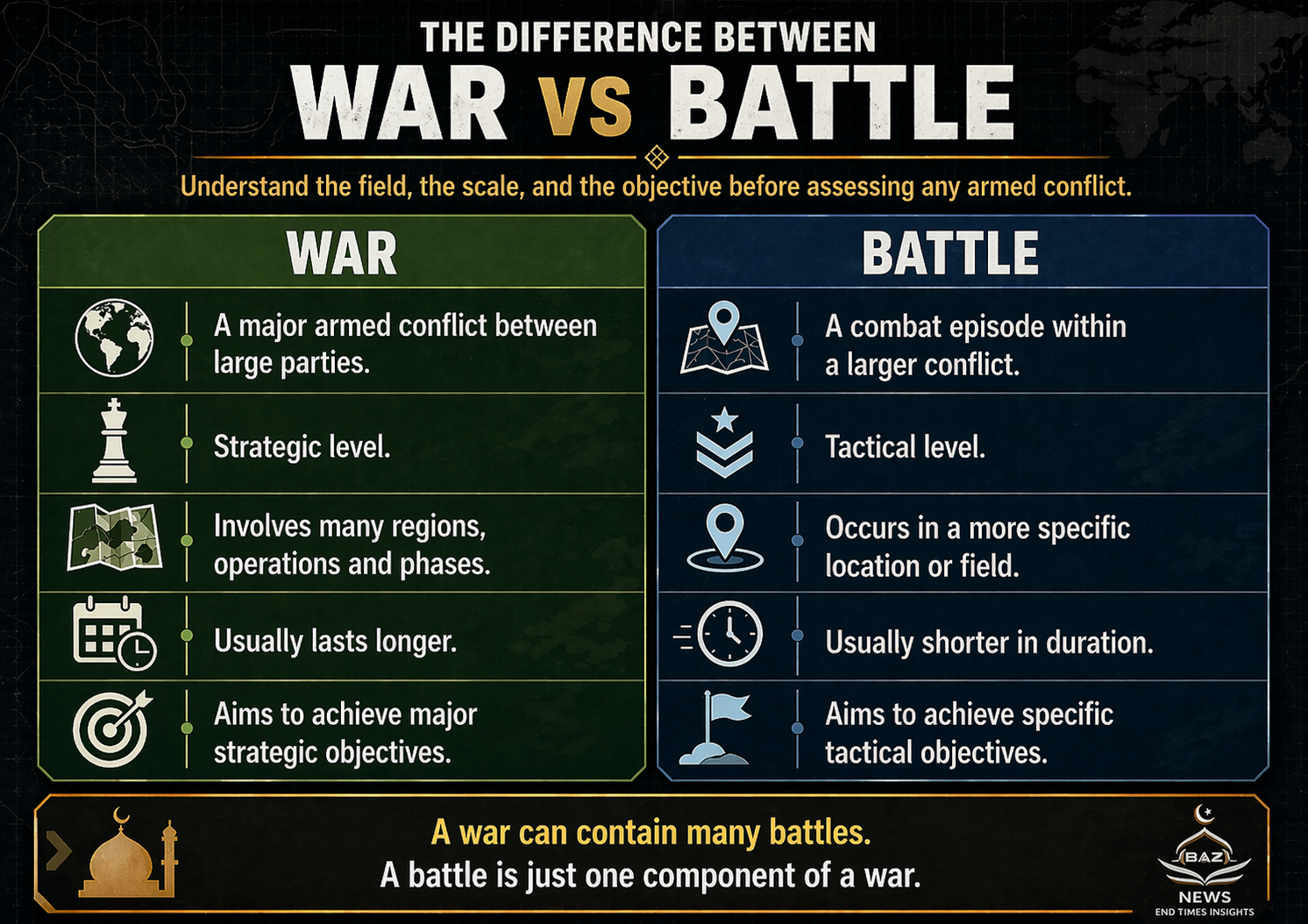
When we read the hadiths of the end times, especially hadiths that mention Malhamah Kubra, we cannot immediately read every combat event as a complete war. We must ask with the discipline of warfare whether the hadith is describing the entire war from beginning to end, or whether it is only describing one major battle within a wider war.
This question is not merely about terminology. It determines how we arrange the chronology, read the location, understand troop movements and assess the position of an event within the end-time map. If the basic term is already misunderstood, then the whole understanding that follows may also go off course.
That is why the difference between war and battle must be clarified early. War is the larger framework. Battle is the combat event that takes place within that framework. A hadith may mention one battle location, but that does not necessarily mean the entire war only takes place in that location.
Therefore, when reading the hadith of A‘maq or Dabiq, the more accurate question is not merely, “Where will Malhamah Kubra take place?” The better question is, “What is the position of A‘maq or Dabiq within the overall framework of the end-time war?” Is it the center of the entire war, the starting point of the war, the climax of the battle or one of the major battlefields within a wider religious war?
That is why the difference between war and battle must be understood from the beginning. Not because we want to sound impressive with military terminology, but because a small mistake in terminology can cause our reading of the end-time hadiths to go off course. A location mentioned in a hadith does not necessarily mean that the entire war takes place there. It may only be the main battlefield within a greater war.
Malhamah Kubra and the Confusion of Terms
As students of the end times, we will encounter many writings and lectures that mention Malhamah Kubra.
Some call it the Great War.
Some call it the end-time war.
Some link it to Armageddon.
Some immediately equate all major end-time events with Malhamah Kubra.
This is where the reading needs to be tightened.
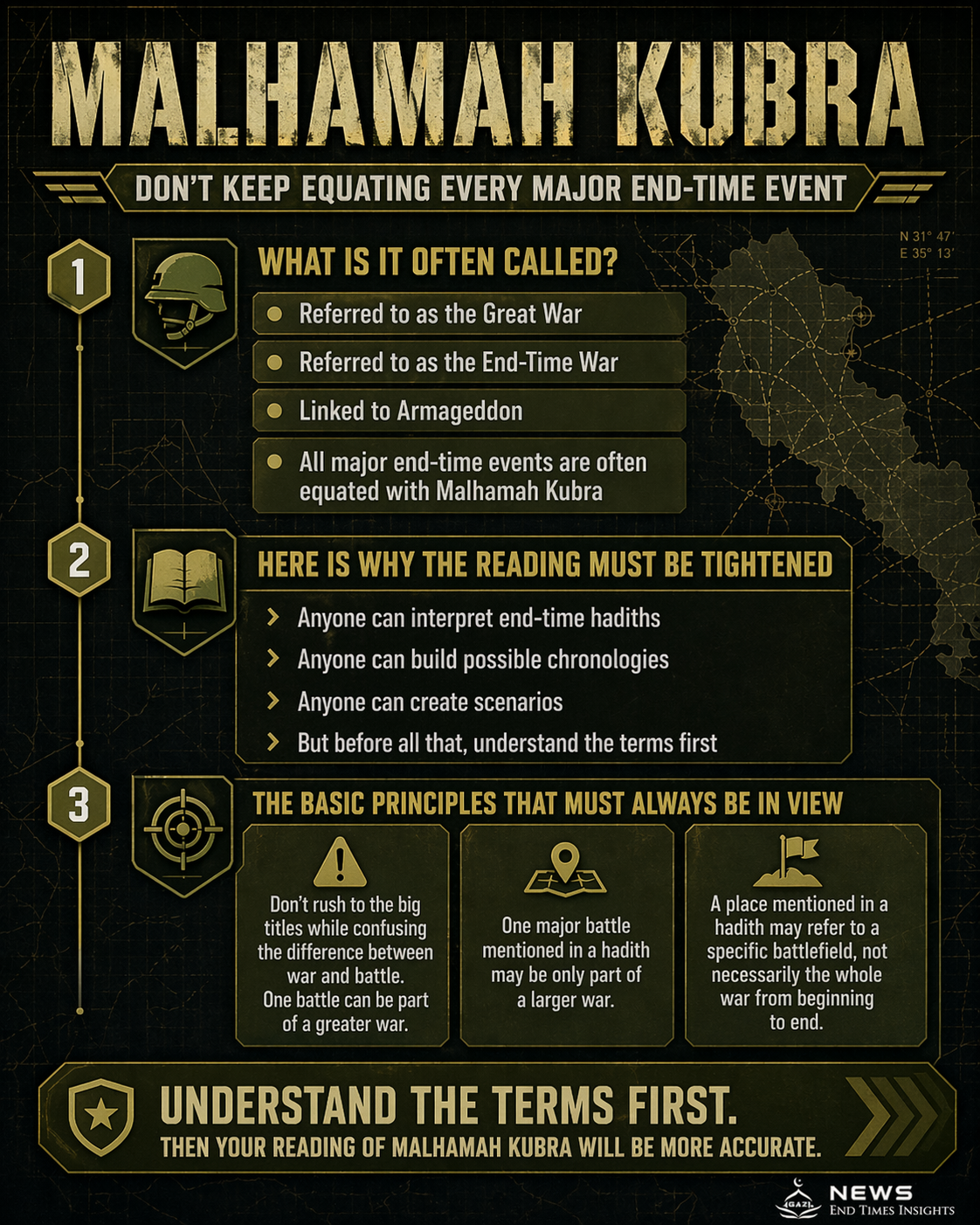
Anyone can comment on end-time hadiths. Anyone can build possible chronologies. Anyone can propose scenarios.
However, before all of that, understand the terms first.
Do not jump straight to the grand title while the difference between war and battle is still unclear.
Because in the actual field, one major battle can be part of a greater war. A place mentioned in a hadith may refer to a specific combat point, not necessarily the entire war from beginning to end.
The Hadith of A‘maq or Dabiq
Among the hadiths often brought into this discussion is the hadith about the Romans descending at A‘maq or Dabiq, two places associated with the area near Aleppo in Syria and Antioch in Turkey.
Referring to the Arabic wording of the hadith is better for accuracy of terminology. The following is the translated meaning of the hadith:
“The Hour will not come until the Romans descend at A‘maq or Dabiq. Then an army from Madinah, consisting of the best people on earth at that time, will go out to face them. When they have arranged themselves in ranks, the Romans will say: ‘Leave us to fight those who took captives from among us.’
The Muslims will reply: ‘No, by Allah. We will not leave you to fight our brothers.’
Then war will take place between them. One third of them will flee, and Allah will never forgive them. One third will be killed, and they will be the best of martyrs in the sight of Allah. One third will gain victory, and they will never be afflicted by fitnah. Then they will conquer Constantinople.
While they are distributing the spoils of war and hanging their swords on olive trees, Satan will cry out to them: ‘The Messiah has appeared among your families.’
So they will leave, though that cry is false. When they arrive in Syria, Dajjal will appear. While they are preparing themselves for battle and arranging the ranks, the time of prayer will come. Then Isa ibn Maryam AS will descend and lead them in prayer.
When the enemy of Allah sees him, he will dissolve as salt dissolves in water. If he were to leave him, he would still dissolve until he perished. However, Allah wants to kill him by his hand. Then he will show them his blood on his spear.”
A Tactical Reading of This Hadith
Observe the sequence of this hadith carefully.
The Romans descend at A‘maq or Dabiq.
A Muslim force comes out from Madinah to face them.
Both sides confront one another.
The ranks are arranged.
Battle takes place.
The combat outcome is clearly mentioned. One third flee, one third are martyred and one third are victorious.
Up to this point, the hadith is describing a specific battlefield. There is a location. There are two opposing sides. There is troop movement. There is the arrangement of ranks. There is battle. There is a battlefield outcome.
That is the characteristic of a battle.
A battle is a combat event that takes place in a specific field, during a specific phase, with the aim of achieving a specific battlefield outcome. In this hadith, A‘maq or Dabiq fulfills that characteristic. It is not mentioned generally as the entire war zone. It is mentioned as the place where the Romans descend and where the Muslim force goes out to face them.
Therefore, from a tactical point of view, A‘maq or Dabiq is more accurately read as a major battlefield.
However, the hadith does not stop at A‘maq or Dabiq.
After that battle, the conquest of Constantinople takes place.
After that, they divide the spoils of war.
Then a false report appears that Dajjal has emerged among their families.
After that, they move to Syria.
Then Dajjal truly appears.
While they are preparing themselves and arranging the ranks, the time for prayer arrives.
Isa ibn Maryam AS descends.
Finally, Dajjal is killed.
This shows that the framework of the hadith is wider than one battlefield at A‘maq or Dabiq alone. This hadith does not only mention one battle, but it arranges several major phases after that battle.
There is the phase of Roman movement.
There is the phase of the Muslim force going out.
There is the phase of battle at A‘maq or Dabiq.
There is the phase of victory.
There is the phase of the conquest of Constantinople.
There is the phase of distributing the spoils of war.
There is the phase of false information about Dajjal.
There is the phase of moving again to Syria.
There is the phase of Dajjal’s emergence.
There is the phase of Isa AS descending.
There is the phase of Dajjal being killed.
This is where the difference between battle and war becomes clear.
A‘maq or Dabiq is the battlefield.
The wider sequence of events involving the Romans, the Muslims, Constantinople, Syria, Dajjal and Isa AS has already entered the space of a greater war.
Battle takes place on the field.
War moves through several fields.
Battle produces a combat outcome.
War produces major changes in the arrangement of power, territory and historical movement.
The battle at A‘maq or Dabiq has a battlefield outcome, namely one third flee, one third are martyred and one third are victorious.
However, the wider war is not finished there, because after that there is still the conquest of Constantinople, movement to Syria, the emergence of Dajjal and the descent of Isa AS.
Therefore, the question that should be asked is not merely:
“Where will Malhamah Kubra take place?”
The more accurate question is:
“Is A‘maq or Dabiq the entire war, or is it the main battlefield within the end-time religious war that is wider?”
Based on the sequence of the hadith, A‘maq or Dabiq should not be read as the entire war from beginning to end. It is more accurately understood as one major battle within a wider war.
This is why the difference between war and battle must be explained from the beginning. Otherwise, when one location is mentioned in a hadith, readers may immediately assume that the entire war only takes place there. In a field reading, one location can be the main battlefield, not the whole war.
Therefore, the tactical conclusion is this:
A‘maq or Dabiq is a major battlefield.
Malhamah Kubra should be read within the framework of a major war that contains several phases after that.
Conclusion
In conclusion, war and battle are not the same. War is the larger framework of an armed conflict that may involve many territories, many operations, many phases and several major outcomes. Battle is one combat episode within that war. It takes place on a more specific field, within a more limited period and with a clearer battlefield outcome.
Therefore, when reading the hadiths of the end times, we must be careful to distinguish between the two. A battle location mentioned in a hadith does not necessarily mean that the entire war only takes place there. It may be a major battlefield within a wider war.
Reply to: