

 English
 Bahasa Melayu
8 Key Similarities Between The 10 Commandments and the Quranic List of Commands to Bani Israel
Series: Malaysia Is About to Be Attacked, Because This Is the Land of Bani Israel
Now that we have looked at these two presentations, one from the Old Testament and the other from the Quran, the best first step is to identify the points of similarity between them. This step is crucial so that none of us fall into the mistake of assuming that everything found in the Old Testament must be rejected wholesale. That is not necessary.
The correct method is to use the Quran as the criterion. Whatever still agrees with the Quran is where we can see the remaining trace of the original revelation. As for anything that contradicts it, falls short, has been altered, or fails to carry the full meaning of Allah’s covenant, none of that can be taken as authoritative. That is why we must begin with the similarities before moving on to the differences.
Required Reading Before Continuing This Article
Before continuing, you are required to read the foundational article below first:
Essential Foundations That Must Be Understood Before Reading This Article
This article must not be read in isolation from that foundation. Do not continue reading this article with a mind already filled with assumptions. Do not read it through an old framework that has become used to locking Surah al-Isra’ into interpretations that may not necessarily be placed correctly.
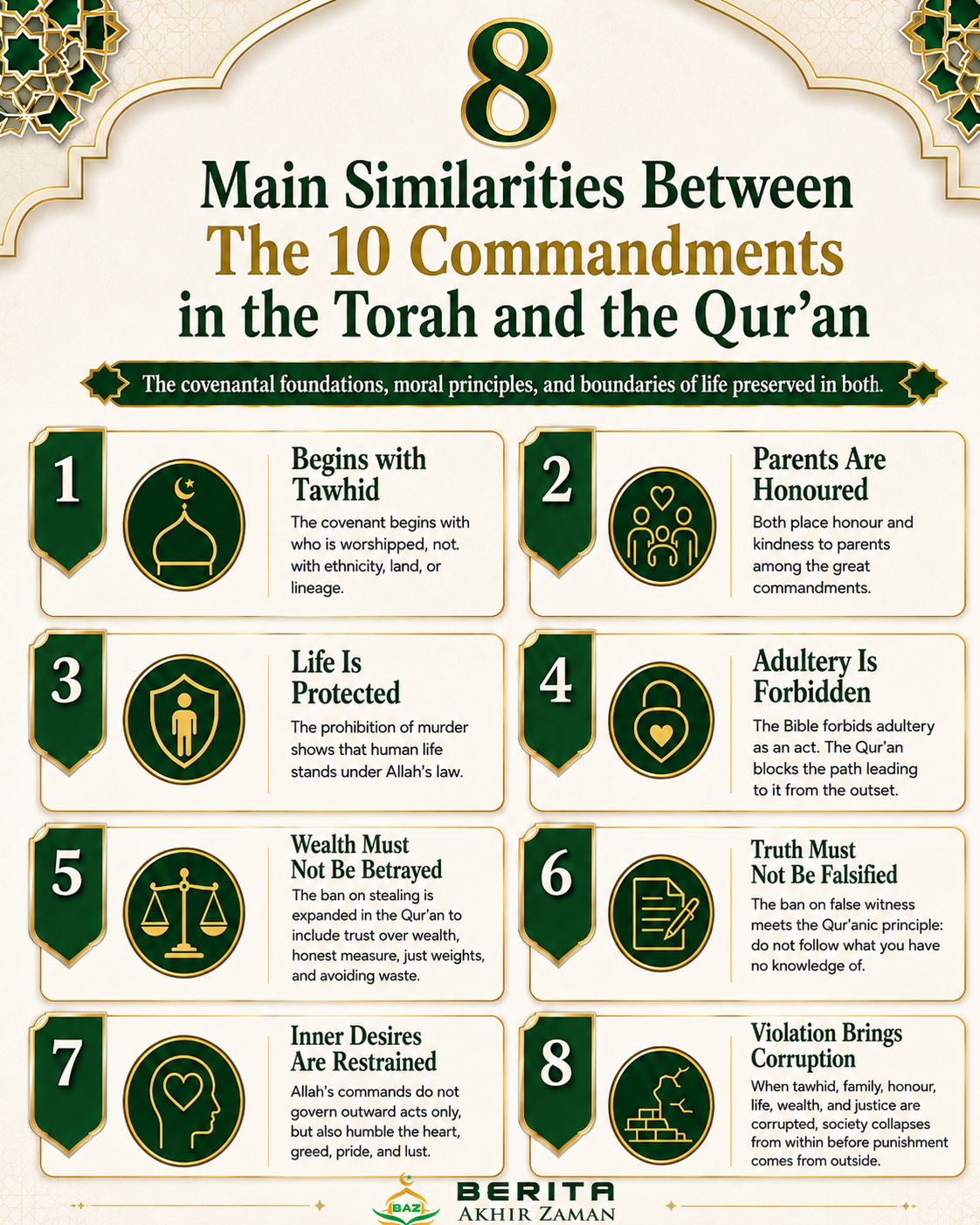
The first and most obvious similarity is that both begin with tawhid.
In The 10 Commandments, the earliest prohibition is that there must be no god besides Allah, and no graven image is to be made for worship.
In the Quran, the structure of command opens with the words of Allah, لَّا تَجْعَلْ مَعَ ٱللَّهِ إِلَـٰهًا ءَاخَرَ. This shows that the foundation of the covenant remains the same.
Bani Israel were commanded not to place another ilah alongside Allah. So at the most basic level, we can see very clearly that the covenant begins with tawhid, not with ethnic identity, not with possession of land, and not with the privilege of lineage.
It begins with who is worshipped. Tawhid is the first and highest matter.
The second similarity is that both place the relationship with parents among the gravest of obligations.
In The 10 Commandments, there is a clear command to honor one’s father and mother.
In the Quran, the matter appears in far greater detail. Allah does not merely command good treatment toward both parents. He forbids even saying “uff,” forbids rebuking them, commands that noble words be spoken to them, commands humility before them, and commands supplication for mercy upon them.
This shows that the foundation of the command is the same, namely that parents hold an exceptionally high place in Allah’s covenant with Bani Israel. The difference is that the Quran unfolds that command with greater preservation and greater refinement.
The third similarity is the prohibition of killing.
In The 10 Commandments, there is a direct and unmistakable prohibition against killing.
In the Quran, Allah commands that no soul which Allah has made sacred may be killed except by right.
This shows that human life is protected in both structures of command. The shedding of blood is not a minor matter. It is one of the major violations of the covenant. In fact, the Quran goes further by setting out the framework of right, injustice, lawful authority, and limits so that people do not transgress even in matters of retaliation.
So the similarity is clear. Human life stands under the protection of Allah’s law.
The fourth similarity is the prohibition of adultery.
In The 10 Commandments, the command is stated directly: do not commit adultery.
In the Quran, Allah says, وَلَا تَقْرَبُوا۟ ٱلزِّنَىٰٓ. Here, we do not merely see similarity in substance. We also see that the Quran brings a deeper level of emphasis.
The 10 Commandments forbid adultery as an act. The Quran is stricter. It forbids people even from approaching it. In other words, the pathways that lead to adultery are also closed.
Although the mode of expression differs, the core prohibition is the same. Honor, family, lineage, and the sanctity of human relations must be preserved.
The fifth similarity is the prohibition of taking the rights of others unlawfully.
In The 10 Commandments, this appears in the form of the prohibition of stealing.
In the Quran, that framework is expanded into several branches. Among them are the prohibition against approaching the wealth of the orphan except in the best manner, the command to give full measure, the command to weigh with a just balance, and the prohibition against wastefulness.
This shows that the original spirit of the command remains the same, namely that wealth must not be betrayed. Wealth is not a free space to be seized, robbed, manipulated, or ruined. It falls within the bounds of trust that Allah has set.
So even though the wording is not identical point for point, the moral foundation remains very close.
The sixth similarity is the prohibition of falsehood and the corruption of truth.
In The 10 Commandments, there is a prohibition against bearing false witness against another person.
In the Quran, that prohibition appears in a broader form, namely that one must not follow that of which one has no knowledge. Hearing, sight, and the heart will all be questioned. This is of great importance.
The 10 Commandments close the door to false testimony at the level of social dealings and judicial conduct. The Quran closes the entire road to falsehood at its root. Do not speak, judge, accuse, spread claims, or follow anything without knowledge.
So both meet upon one major principle, namely that human beings must never stand upon falsehood, fabrication, slander, or false accusation.
The seventh similarity is that both seek to regulate the inner desires of man, not merely his outward actions.
In The 10 Commandments, this is most clearly seen in the prohibition against coveting what belongs to others. The point is not simply that one must not steal. One must not nurture within the heart a desire to seize what is not rightfully one’s own. Many evils begin in the heart first, and only later appear in outward action.
In the Quran, although the exact wording “do not covet” does not appear in the same form, the same spirit is present in the prohibition of wastefulness, the prohibition of excessive stinginess, the prohibition of approaching zina, the prohibition of walking in arrogance, and the prohibition of following anything without knowledge.
All of this shows that Allah’s covenant does not seek only to restrain the hands and feet of man in the physical sense. It also seeks to subdue his soul and his desires in the spiritual sense.
The eighth similarity is that both carry the message that violation of Allah’s commands is not merely a ritual sin, but a corruption of life that destroys society.
The 10 Commandments safeguard tawhid, family, honor, life, property, and justice.
The Quranic structure in Surah al-Isra’ safeguards the same things, while adding ihsan, mercy, trust, adab, and responsibility in matters of knowledge.
This shows that neither comes as a set of isolated legal points standing on its own. All of this comes to shape a way of life. When these basic matters begin to be corrupted, society itself begins to decay, little by little, from within. Once that decay reaches a certain point, punishment then comes from without.
Conclusion
From these similarities, we can already see one very important truth. The 10 Commandments as found in the Old Testament are not without any basis at all. There are still traces of the original commandments that Allah once gave to Bani Israel. But those traces cannot be left to stand on their own. They must always be brought back to the Quran.
It is the Quran that determines what remains true. It is the Quran that corrects what has become crooked. It is the Quran that reopens what has been concealed.
That is why studying this section of similarities matters. We are not taking religion from a text that has been altered. Rather, we are showing that the original command truly did exist, and that the Quran came to preserve its essence in a protected form. What we are seeing here is the majesty of the Quran.
Even so, we must remain honest and careful. These similarities do not mean that the two are fully identical and equally fit to be accepted. They only show that there are still some traces that align with the revelation Allah has preserved.
Beyond those similarities, there are parts that have changed, parts that have been lost, parts that have become obscure, and parts that the Quran reopens with far greater force.
That is why we cannot stop at the section on similarities alone. We must now move into the section on differences, so that we may see more clearly where the original trace still remains and where distortion has taken place.
More importantly than that, we must not forget the true mission of this discussion. We are not merely comparing two sets of commandments for the sake of intellectual study. We are examining a covenant in order to identify where the major violation lies that brought Allah’s punishment upon Bani Israel.
This process matters greatly because we are tracing the factors that paved the way for the second attack, the attack that will destroy Bani Israel in this very homeland of ours. That is why this section on similarities is only the beginning. Next we must enter the section on differences, because there it will become clearer which parts were altered, which parts were concealed, and how all of this is tied to a punishment that has not yet reached its conclusion.
 Click to support us.
Reply to: