

 English
 Bahasa Melayu
They Attacked Istana Melaka Before. Will They Attack Istana Negara Later?
Series: Malaysia Is About to Be Attacked, Because This Is the Land of Bani Israel
Introduction
One day, Istana Negara, which we honor, love and uphold as the symbol of national sovereignty, may face a very great trial. No civilization remains forever without being tested. No institution is guaranteed safety if Allah has decreed that a warning should befall a people.
Although this topic is sensitive, I still have to write about it. Not because I hate the palace institution. Not because I wish to cause fear. Rather, I write because I see a very heavy indication in the Qur’an, especially concerning the second attack mentioned in Surah Al-Isra’.
I write because I care. I write because I want to give a warning. I write because I believe that a warning from the Qur’an must not be hidden merely because it touches upon a sensitive matter.
For those who have just come across this article, this writing is part of the series “Malaysia Is About to Be Attacked, Because This Is the Land of Bani Israel” published on beritaakhirzaman.com. This series discusses the relationship between Surah Al-Isra’, Bani Israel, the blessed land and the possibility of a second attack as mentioned by Allah in those verses.
Required Reading Before Continuing This Article
Before continuing, you are required to read the foundational article below first:
Essential Foundations That Must Be Understood Before Reading This Article
This article must not be read in isolation from that foundation. Do not continue reading this article with a mind already filled with assumptions. Do not read it through an old framework that has become used to locking Surah al-Isra’ into interpretations that may not necessarily be placed correctly.
The Background Of The First Attack And The Second Attack
As we have discussed before, Surah Al-Isra’ mentions that Bani Israel will commit fasad and uluww twice. Both occur when they violate the commands of Allah. Those commands are also known in the Old Testament as The 10 Commandments, then explained again by Allah in Surah Al-Isra’ verses 22 to 39, Surah Al-Isra’ verses 22 to 39.
As a result of the first violation, Bani Israel are attacked as punishment. After that, they are restored again to rise. However, when they once again violate the command of Allah, then comes the second attack. This attack is not merely an ordinary attack, but the final attack that brings destruction with utter devastation.
According to my research, this event takes place in the Malay Peninsula. I have also presented various justifications from the Qur’an that Prophet Musa and Prophet Harun brought Bani Israel toward the Malay Peninsula. The small number of Bani Israel who were in the Arabian Peninsula, according to my reading, were the disobedient group who were left behind along the journey of the prophets. They later used the name Bani Israel and formed the religious identity of Judaism.
In reality, the main body of their believing people continued the journey to the mashriq until they reached the edge of Ardhul Muqaddasah, which is the region I place in this Malay Peninsula.
Although not all arrived together with Prophet Musa and Prophet Harun, some of them arrived later with other prophets from Bani Israel, including Prophet Dawud and Prophet Sulaiman. Others, without realizing it, reached the Malay Land through British colonialism, either as workers in the colony or through migration currents that eventually led to citizenship through the principle of Jus Soli.
You will understand what I mean better if you read the sub-article From Melaka 1511 to Independence 1957: The Effects of the First Attack.
In my view, the Portuguese, Dutch and British colonization was the picture of the first attack, especially against the palace and the center of power in the Malay Land. Now, when the Qur’anic verse mentions that they will enter again just as they had entered the first time.
The Special Keyword, Masjid
In this section, we are not discussing the characteristics of the second attacker. Rather, we are discussing one special keyword for identifying the palace, namely “masjid”.
In verse 7 of Surah Al-Isra’, Allah SWT says:
إِنۡ أَحۡسَنتُمۡ أَحۡسَنتُمۡ لِأَنفُسِكُمۡ ۖ وَإِنۡ أَسَأۡتُمۡ فَلَهَا ۚ فَإِذَا جَآءَ وَعۡدُ ٱلۡأٓخِرَةِ لِيَسُـُٔواْ وُجُوهَكُمۡ وَلِيَدۡخُلُواْ ٱلۡمَسۡجِدَ كَمَا دَخَلُوهُ أَوَّلَ مَرَّةٍ وَلِيُتَبِّرُواْ مَا عَلَوۡاْ تَتۡبِيرًا
If you do ihsan, that ihsan returns to yourselves. If you do evil, the evil consequence also returns to yourselves. Then, when the second promise comes, it comes so that they may disgrace your faces, so that they may enter al-Masjid as they entered it the first time and so that they may destroy whatever the attacking party manages to dominate with a destruction that is utterly devastating.
(QS. al-Isra’ 17: Ayat 7)
Read The Definition Of Masjid According To The Qur’anic Verses
Before this, I asked readers to look for themselves at the Qur’anic verses that mention masjid. The purpose is simple. We want to understand the characteristics of masjid according to the verses, not according to our own assumptions.
When I say the characteristics of masjid must follow the verses, it means that we must return to what Allah has mentioned. Do not put our opinion first. Do not immediately lock the meaning of masjid to a prayer building alone. Read the verses first. Observe its function, role and position in the Qur’an.
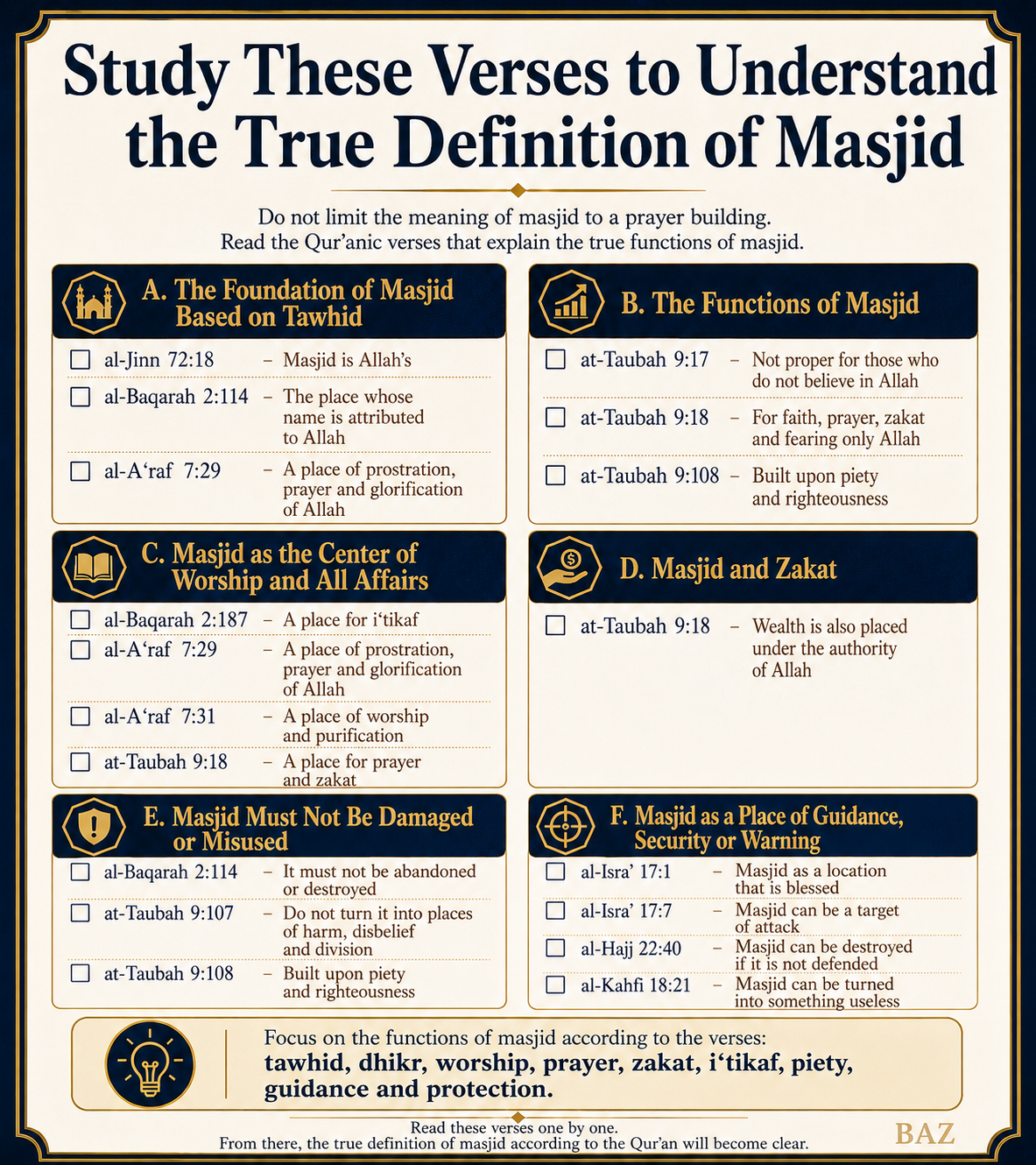
From there, we will begin to understand that masjid must be read according to Allah’s definition, not merely according to the common definition of human beings.
I am not building my own definition. I use the method of tafsir al-Qur’an bil-Qur’an. Every verse is explained with another verse so that its meaning does not deviate from the framework of the Qur’an itself.
This meaning does not come from me. If I give my personal opinion, I will state that it is my opinion.
Why I Asked You To Read About Masjid
I asked you to read the verses about masjid because in Surah Al-Isra’ verse 7, when the second promise arrives, Allah mentions that they will enter into al-masjid.
The question is, what is meant by al-masjid in that verse?
The wording used is singular. Not plural. Not many masjids. Not all masjids. Allah mentions one specific masjid.
Interestingly, Allah does not name that masjid. Allah does not mention Masjidil Haram. Allah does not mention Masjid Nabawi. Allah does not mention Masjidil Aqsa. Allah also does not give any other specific name.
What is mentioned is only al-masjid, meaning one masjid that will be entered as they had entered it the first time.
So what we must ask is:
Where did they enter the first time?
In my opinion, the first entry is connected to Melaka. Masjid Melaka was destroyed together with its city when the first attack took place.
If so, when the verse mentions that they will enter again just as they entered the first time, then we need to ask again:
Which masjid is meant the second time?
My Opinion About al-Masjid In This Verse
This section is my opinion. The previous section was based on observation of the wording and structure of the verse.
That is why I asked readers to first understand the meaning of masjid according to the Qur’an. Do not jump straight to a conclusion. Do not read the word masjid only with the image of a prayer building.
In my reading, if the masjid in the first attack refers to the center of power in Melaka, then the masjid in the second attack refers to the center of national power today.
That is why I once said that the masjid in the first attack was Istana Melaka. In the second attack, I see that it possibly refers to Istana Negara.
The question is, why Istana Negara?
This answer must be understood through the function of masjid in the Qur’an, the function of masjid during the time of the prophets and how that greater function changed within the modern system of government.
The Context Of This Verse Is Not An Attack Against The Royal Institution
Before we go further, the first thing that must be understood is the context of this verse. This discussion is not a call to attack the royal institution. Nor is it a writing intended to incite people to hate the palace, the raja or the governing system of the country.
Rather, this writing attempts to read a major indication in Surah Al-Isra’ verse 7, namely when Allah mentions that at the second promise, the party being sent will enter into al-masjid as they entered it the first time.
This is where many major questions arise, such as:
- What is meant by al-masjid in that verse?
- Must it necessarily be a prayer building?
- Must it necessarily be a named masjid such as Masjidil Haram, Masjid Nabawi or Masjidil Aqsa?
- Or must the wording al-masjid be understood through its greater function in the Qur’an, namely as a center of obedience, a center of the affairs of the ummah, a center of law, a center of trust, a center of worship, a center of zakat and a center of authority that submits to Allah?
I write this section because I support sovereignty. I am not writing to bring sovereignty down. I write because I see that sovereignty is being slowly weakened. Attacks against major institutions usually do not begin with physical attacks. They begin with attacks on meaning, attacks on trust, attacks on legitimacy, attacks on narrative and attacks from within the minds of the people themselves.
That is why, when I connect al-masjid with the palace, it does not mean I am calling people to attack the palace. What I mean is that we need to understand how the great function of masjid during the time of the Prophet changed form, became fragmented, moved and eventually came largely under the authority of the institution that safeguards religion in the country.
If you as a reader do not understand this logical path, you will continue to assume that masjid only means a prayer building. Therefore, when reading verse 7 of Surah Al-Isra’, you will immediately look for a mosque building. Yet in the Qur’an, masjid is not merely a place of floors, pillars, pulpits and domes. Masjid is a place of prostration to Allah in the greater meaning, meaning a place where human beings submit to the command of Allah, manage the trust of Allah and establish the affair of Allah.
The Function Of Masjid During The Time Of The Prophet
To understand this meaning, we must first return to the function of masjid during the time of the Prophet.
During the time of the Prophet, the masjid was not merely a place for congregational prayer. The masjid was the center of the life of the ummah. There, prayer was established. There, the revelation of Allah was recited. There, the Muslims were taught. There, every ruling was explained. There, people came to ask questions. There, decisions were made. There, society was built.
The masjid during the time of the Prophet combined many functions that today have been separated into various institutions. In the past:
- Worship was in the masjid.
- Knowledge was in the masjid.
- Administration was in the masjid.
- The discussion of the ummah was in the masjid.
- Judgment was in the masjid.
- The matter of zakat was in the masjid.
- Public calls to society were in the masjid.
- The poor had a place to complain in the masjid.
- Outsiders had a place to meet the leader of the ummah in the masjid.
- The ummah had a place to understand the direction of struggle, the direction of governance and the direction of their lives in the masjid.
This means that the masjid during the time of the Prophet was not only a center of worship. It was a center of civilization that affirmed tawhid to Allah. Everything was there, including and not limited to:
- Its prayer was there.
- Its zakat was there.
- Its counsel was there.
- Its decisions were there.
- Its moral authority was there.
- Its social authority was there.
- The political authority of the ummah was also connected to that center.
That is why I said from the beginning that when the Qur’an mentions masjid, we cannot immediately reduce its meaning to a prayer building alone. The building is indeed a masjid, but the function of masjid in the Qur’an is far greater than the building.
Masjid is the place where human beings prostrate to Allah, not only with the forehead on the floor, but with the whole system of life submitting to the command of Allah.
Masjid As The Center Of The Ummah’s Authority, Not Merely A Prayer Building
When people hear the word masjid, they immediately imagine a building for prayer. They see prayer mats, a pulpit, the adhan, an imam, a bilal, Maghrib lectures and Friday prayers. They enter the masjid intending i’tikaf. When they have a stomachache, they stop at the masjid because there is a toilet.
All of that is true. All of that is also part of the masjid. However, it is not yet sufficient to understand masjid in its comprehensive meaning.
Originally, the masjid was the center where society submitted to Allah. People came there not only to pray, but to surrender the affairs of life to the guidance of Allah. From there emerged education, law, zakat, trust, leadership and the management of society.
That is why, when masjid is understood only as a worship building, we automatically lose its true meaning. We will fail to see that some of the functions of masjid have moved out of the masjid building and entered departments, councils, courts, boards, palaces and structures of government.
The masjid building still exists, the adhan still resounds, prayer is still established and lessons still continue as usual according to schedule. However, many of the great functions that used to be around the masjid have now been centralized in other institutions.
This is not necessarily wrong in the context of modern administration. A modern state indeed operates with departments, laws, administrative authority and official structures. However, in the discussion of this verse, we need to ask:
If the greater function of masjid has moved to other institutions, then when the Qur’an mentions al-masjid in the context of a center entered by the attackers, do we only need to look for a building for prayer?
Or do we need to look for the center of authority that inherits the greater function of the masjid?
After The Colonizers Came The First Time
When the colonizers came to the Malay Land, they did not necessarily abolish the raja and the sultan outright. Many sultanates were preserved. The raja was still there. The palace was still there. Custom was still there. Religion was still called the affair of the raja. However, real power began to change.
In many situations, the British Resident became the center of administration. The Resident advised the raja. That advice had to be followed in state affairs, except in matters of Islam and Malay custom. This means that power had been split.
The raja still held religion and custom. The Resident held administration, economy, natural resources, civil law and the political direction of the state. Here, a major change took place from the perspective of the function of masjid.
If during the time of the Prophet, the masjid gathered the affairs of worship, law, economy, zakat, judgment and administration of the ummah, then during the colonial period that function began to be separated.
- Some functions remained with the raja.
- Some functions were taken by the colonizer.
- Some functions remained with the village masjid.
- Some functions entered the administrative office.
That is why I say the function of masjid was split. Not that the masjid as a building was split, but that the great function of masjid as the center of the ummah, which should have been like the time of the Prophet, was split.
- The raja guarded religion.
- The Resident guarded the state.
- The masjid guarded prayer, khutbah, teaching and the local community.
On the surface, everything appeared to be proceeding as usual. However, from the perspective of the structure of power, the masjid was no longer the full center of the life of the ummah as it was during the time of the Prophet. That center had been broken into several bodies of authority.
The Village Masjid Before The Current System Became Strict
Even so, the village masjid in the past still had a large space in society. The village masjid was not merely a place of prayer. It was still a community center. Villagers gathered there. Elders discussed there. Young people learned there. Community problems were brought there. Small community decisions sometimes began there.
Friday khutbahs were closer to the local atmosphere. Religious talks were more open. Local scholars could teach. Zakat was sometimes given directly to known poor people. Assistance happened directly. Waqf, charity, feasts, learning circles, funeral matters, the affairs of the poor and community matters all revolved around the masjid.
This means that although the greater function of masjid had begun to be split since the colonial period, the remaining strength of the masjid as the center of society was still deeply felt in the villages. The masjid was still close to the people and the masjid was still alive as the pulse of society. The masjid was still a place people came to, not only for prayer, but also to settle part of the affairs of life.
Here, if we examine carefully, we can see the difference between masjid as a building and masjid as a function. For example:
The masjid building may be small, but its social function is great.
The pulpit may be simple, but its influence is strong.
Its fund may not be large, but its relationship with the poor is very close.
This is the masjid that still preserved part of the spirit of the great function during the time of the Prophet, even though political and administrative authority had already moved elsewhere.
After Independence And The Westminster System
After Independence, the structure of the country changed once again. The Malay Land was no longer directly ruled by the colonizer. We had the Federation as a combined structure. We had the Constitution as the highest law. We had our own government, we had Parliament, we had the courts, we had departments and ministries. We also had a modern administrative system and we also had a constitutional monarchy.
In this system, the raja and sultan still exist. The palace still exists. Sovereignty still exists. Islam still remains under the position of the raja in certain states, while the Yang di-Pertuan Agong has a position in certain territories and in the federal arrangement.
At the same time, however, daily governing power is carried out through the modern system.
- There is the Executive.
- There is the Legislative.
- There is the Judiciary.
- There is the Prime Minister.
- There is the Menteri Besar.
- There is the state government.
- There are religious departments.
- There are religious councils.
- There are syariah courts.
- There are mufti departments.
- There are zakat boards.
- There is baitulmal.
- There are waqf departments.
- There are tauliah regulations.
- There are official khutbah texts.
- There are Islamic family laws.
- There are state enactments.
- There is Islamic banking.
All of these were born within the framework of the modern system after Independence. Therefore, once again, the greater function of masjid moved further away from the village masjid. Before this, the masjid could still function quite broadly in society. However, after the administration of religion became more organized, more and more affairs that were once close to the masjid entered official departments.
- Zakat is no longer freely distributed by the masjid as a full organization.
- Khutbahs are no longer freely prepared by the local community.
- Religious talks can no longer be held as one wishes without tauliah.
- Waqf can no longer be managed freely without registration.
- Marriage can no longer be settled by mosque people without departmental procedures.
- Fatwa no longer comes from the village pulpit, but from the mufti institution.
- Judgment does not take place in the space of the masjid, but in the syariah court.
- Religious administration is no longer in the hands of the mosque committee alone, but in departments and religious councils.
Once again, we must understand carefully. This is not merely criticism of the system. This is a reading of function because we are tracing one question:
Where did the greater function of the masjid go, the function that once gathered the affairs of the entire ummah?
The answer is that the function did not simply disappear. It changed form. It entered the official structure of the state.
The Raja As Head Of Religion
When we reach this stage, only then can we understand the role of the raja and the sultan in this discussion.
We know that the raja cannot become the Prime Minister. The raja also cannot become the Chief Justice, the Attorney General or the Menteri Besar in the ordinary system. The raja no longer manages all branches of daily government like the executive government.
However, the raja has a very important position in matters of Islam. In many states, the sultan is the head of Islam. In certain contexts, the Yang di-Pertuan Agong also has a role as head of religion for certain territories and within the federal arrangement.
From this position arise various religious institutions such as state Islamic religious councils or departments, syariah courts, mufti departments, qadi offices, zakat boards, baitulmal and various other organizations under the authority of the raja or sultan.
All the organizations we see are connected to the religious structure that ultimately comes under the authority of the head of religion, namely the raja and the sultan.
Where is the symbolic center of the authority of the raja and the sultan? Certainly, in the palace.
Therefore, when we trace the greater function of masjid in the modern system, we find that the function is no longer gathered fully in the village masjid. It has been centralized in religious institutions that receive authority from the position of the raja as head of religion.
This is where the palace begins to enter the discussion of al-masjid that we are focusing on in verse 7 of Surah Al-Isra’. Not because the palace is a masjid building, not because the palace is a place where the public performs Friday prayers and not because the palace has a pulpit like a masjid. Rather, because the palace becomes the symbolic center of religious authority that controls the greater functions that once existed within the sphere of the masjid of the ummah.
What Happened To The Once Powerful Masjid In Our Villages
Now we return to looking at the village masjid after the system of control changed. What remains with the village masjid today?
Indeed, the masjid still remains a place of prayer, Friday khutbah, religious lessons, tazkirah, a place where society gathers, a place for funeral matters and many other things. All of that remains important and noble. However, when compared to the function of the masjid during the time of the Prophet, many great functions have moved out from the masjid as a local organization.
Try to think especially about this:
- Can the masjid collect zakat and distribute it fully by itself to the members of the qaryah as an organizational authority? In the current system, not quite. The masjid may have amil. Individuals may be appointed. However, full authority lies with the zakat board or official institution.
- Can the masjid prepare its own khutbah every week based on the actual problems of its own mukim? In many cases, no. The khutbah text comes from the state religious authority.
- Can anyone who has knowledge come to give a religious lecture whenever there is an opening? In the current system, it is not that simple. There are requirements for tauliah and approval.
- Can the masjid manage waqf property freely without registration and control by the religious institution? Not quite. Waqf is subject to official rules and registration.
- Can the masjid marry off the children of its own mukim based only on the trust of the local community? No. Marriage matters are under the religious department and official procedures.
- Can the masjid settle legal disputes in society with judicial authority? No. That is under the syariah court.
- Can the masjid determine the religious policy of the state? No. That lies with the religious council, religious department, mufti and head of religion.
Therefore, it is clear that the masjid as a building still exists, but its greater function has been transferred to another structure. This is what I mean when I say that the masjid today is no longer the same as the masjid during the time of the Prophet.
Not because the masjid today is not noble and has lost its value. Not because we want to belittle the masjid. Rather, I want us to read the change of function as a present reality.
Where Did That Function Go
Those functions still continue, but they have gone to departments, councils, boards, bodies or any structure appointed to manage them.
Most functions have shifted to new departmental structures. All these new institutions receive authority from the law, the Constitution, enactments and the position of the head of religion.
Who is the head of religion? The raja and the sultan.
Where is the symbolic center of the raja and the sultan? The palace.
Therefore, when we trace the function of masjid in stages, the logical path becomes like this:
- During the time of the Prophet, the greater function of the ummah was in the masjid.
- During the colonial period, that function began to be split between the raja, the masjid and the colonial administration.
- After Independence, that function was reorganized within the modern state system.
- In the modern system, religious function no longer exists fully within the village masjid, but within departments, councils, courts, boards and religious institutions.
- These institutions are under the authority of the head of religion.
- The head of religion is the raja and the sultan.
- The symbolic center of the authority of the raja and the sultan is the palace.
- Therefore, from the angle of its greater function, the palace becomes the center of masjid authority in modern form.
- The palace is al-Masjid.
This is the continuation of the logic. If you become disconnected at any stage, you will misunderstand. You will assume that I am saying the palace is a masjid in the form of a building. That is not what I mean. What I mean is that the palace holds the center of authority that, during the time of the Prophet, was within the greater function of the masjid.
Why I Place al-Masjid As The Palace
Now we return to Surah Al-Isra’ verse 7. In that verse, Allah mentions that when the second promise comes, they will enter into al-masjid as they had entered it the first time.
Observe the wording. Allah mentions al-masjid. Not masajid. Not many masjids. Not all masjids. Not a masjid whose name is clearly stated.
Rather, al-masjid is one specific masjid, with alif lam, in the context of a second entry that resembles the first entry.
What was the center entered the first time? In my research, the first attack in the Malay Land occurred through the fall of Melaka. When Melaka was attacked, the center of Melaka’s power collapsed. The city of Melaka collapsed. Istana Melaka collapsed. Masjid Melaka also perished within the collapse of that center of power.
Therefore, the first time, what was entered was not merely a building. What was entered was a center of power. A center that controlled governance, possessed sovereignty, sheltered religion, served as a community center and stood as the center of the state. That was Melaka.
If so, when the verse mentions that they will enter again as they entered the first time, then we cannot merely look for a village masjid or an ordinary prayer building. We must look for a center that corresponds to the function of the first time.
During the era of Melaka, that center was the palace and the city of Melaka. In the modern era, the center of national sovereignty is Istana Negara. That is why I place al-masjid in verse 7 as Istana Negara, if the target is the country.
I choose this not because Istana Negara is a masjid from the perspective of a building. Not because the people perform Friday prayer there. Not because it replaces the masjid. Rather, because the greater function of the masjid, which is connected to religious authority, the trust of the ummah, sovereignty, law, zakat, religious administration and the protection of society, has been centralized in a structure that ultimately connects to the palace as the symbol of the head of religion and national sovereignty.
In other words, the palace is the symbolic center of the greater function of the masjid in the modern system. This is why I mention that the single building named al-masjid in this verse most precisely refers to Istana Negara.
Is The Target The Country Or Muqaddasi Tuwa
However, in this matter, I remain cautious. If the target is the country as a whole, then the greatest center is Istana Negara. If the target is the specific region of Muqaddasi Tuwa, then the more precise center may be connected to Istana Kedah.
This is because the larger theory I have built places Muqaddasi Tuwa in Kedah Tua. If the second attack moves toward the center of the country, then my reading points toward Istana Negara. If the second attack moves toward the center of the land of Muqaddasi Tuwa, then that reading must also evaluate the position of Istana Kedah.
I am not giving a final decision recklessly. I am helping all of you understand a reading based on the verse, the function of masjid, the history of the first attack, institutional change and the position of the center of power in the current system.

Reply to: