

 English
 Bahasa Melayu
Understanding Mashriq from the Quran
The word mashriq is a very interesting term to pay attention to, especially when we speak about end-time hadith related to Imam Mahdi and the Black Banners. This term does not only appear in hadith, but can also be found in the Quran in various forms and contexts. When all of these verses are gathered, we will find that the discussion touches on the issues of the qiblah, Isra’ and Mi‘raj, Masjid al-Aqsa, Prophet Musa, Bani Israel, and several other major narratives.
Based on my review of the relevant Quranic verses as well as my reading of several tafsir works and earlier writings, I find that there are still some areas that can be further refined. Some earlier discussions have already provided a very important foundation, but in my view, there are certain aspects that can still be re-examined and reconsidered with broader analysis, in line with the level of knowledge and information available in this age.
In the Quran, I have identified 17 occurrences of words derived from the root related to mashriq in various forms. I list them all below so that readers may take each verse I refer to, then examine them independently through tafsir works, lexical explanations, and where relevant, directly consult the asbab al-nuzul for each verse.
The Purpose of This Writing
The purpose of this writing is to further refine certain discussions of earlier scholars at specific points, and then to share with all of you what I have found throughout my own review and research.
Without concealment, I want to state that in several other writing series, I am currently exposing a major deception which, in my view, has afflicted Muslims, Jews, and Christians for thousands of years. This deception is connected to the manipulation of the history of Bani Israel, the qiblah, the Promised Land, the movement patterns of the prophets, and the migration of humanity back again in the end times.
What I am writing on this page actually sits within a larger framework in which each part is interconnected, whether I state those links directly or not. This writing on mashriq is only a small part of a wider effort to explain certain definitions, terms, and the positions of specific matters.
A Reminder to the Readers
I would like to remind all readers, whether new or old, that what I am writing here is not something final and absolute. Therefore, read carefully, examine every argument that I put forward, and make reference checks for every point that I present. Whether I state a proof directly or do not state it at a certain place, I always have a reason. God willing, I am very careful in choosing words, spelling, and constructing sentences.
More importantly, whenever I mention Quranic verses, then open them, read them, ponder them, and take heed. He is the One who grants guidance, not me, not your effort, and not your intelligence. We may seek knowledge, examine information, and arrange words and arguments, but the One who grants understanding is He alone.
List of Verses Related to Mashriq in the Quran
Below are the verses that I have listed for you to examine on your own, especially by referring to the relevant tafsir works.
- Al-mashriq (المشرق)
- Al-Baqarah 2:115
- Al-Baqarah 2:142
- Al-Baqarah 2:177
- Al-Baqarah 2:258
- Ash-Shu‘ara’ 26:28
- Al-Muzzammil 73:9
- Al-Mashāriq (المشارق)
- As-Saffat 37:5
- Al-Ma‘arij 70:40
- Mashāriq al-arḍ (مشارق الأرض)
- Al-A‘raf 7:137
- Mashriqayn (المشرقين)
- Az-Zukhruf 43:38
- Ar-Rahman 55:17
- Ashraqat (أشرقت)
- Az-Zumar 39:69
- Ishrāq (إشراق)
- Sad 38:18
- Mushriqīn (مشرقين)
- Al-Hijr 15:73
- Ash-Shu‘ara’ 26:60
- Sharqiyy (شرقيّ)
- Maryam 19:16
- Sharqiyyah (شرقية)
- An-Nur 24:35
A Brief Overview of Earlier Scholarly Discussions
I would like to briefly cite what earlier scholars specifically explained regarding the word mashriq, its root, and several other derived forms. Of course, it is impossible for me to gather everything here. Therefore, whoever wishes to delve deeper into this issue must continue the examination independently through tafsir works, linguistic commentaries, and related discussions.
What can be found in the earlier tafsir heritage is very useful as a foundation, especially from the angles of language, transmitted reports, and observation of the order of the natural world. Even so, there is still room for re-examination in certain aspects, especially when a certain expression is touched upon in various verse contexts and can then be compared with the information, disciplines, and research capabilities available today.
A Collection of Earlier Scholarly Interpretations of Mashriq
Below, I have prepared a section that merely gathers the interpretations of earlier scholars so that you as readers may first understand the basic meaning of these expressions. I am not yet bringing in a new argumentative direction. I am only arranging what can generally be seen from the tafsir of al-Tabari, al-Baghawi, Ibn Kathir, and al-Qurtubi.
Let us observe how earlier scholars understood the expression mashriq. When earlier scholars interpreted words from the root ش ر ق, they generally did not move far from one basic axis, namely “the rising of the sun,” “the eastern direction,” “the place of rising,” and “light or the time of sunrise.” From this basis, they distinguished between the singular form, the dual form, the plural form, as well as several other derivatives that appear in the Quran.
For the term al-mashriq (المشرق), al-Tabari explained that it means the place of the sun’s rising or the place where it rises. In his tafsir on Surah al-Baqarah 2:115, he stated that Allah mentions al-mashriq and al-maghrib to show that both belong to Him, together with all that lies between them. This meaning is not taken into some complicated interpretation, but is understood directly as the place of rising and the place of setting, all of which are under the power of Allah.
When the Quran mentions al-mashriq and al-maghrib, earlier scholars usually understood them generally as east and west. The meaning is simple, namely the direction of the rising sun and the direction of the setting sun. Al-Baghawi explained that it refers to the eastern direction and the western direction. Ibn Kathir likewise explained that even though it is mentioned briefly, the meaning still carries the sense that Allah controls all places of rising and all places of setting.
When the Quran uses the dual form, namely al-mashriqayn (المشرقين), the interpretation of earlier scholars generally carries the meaning of the two principal places of sunrise in the course of its yearly movement. What is meant is the mashriq of summer and the mashriq of winter. Al-Tabari mentioned this directly while interpreting Surah ar-Rahman 55:17. Ibn Kathir also brought the same meaning, namely مشرقي الصيف والشتاء. In several reports cited by al-Tabari, these two mashriq are understood as the two major extremes of the changing place of sunrise in a year.
When the Quran uses the plural form, namely al-mashāriq (المشارق), earlier scholars understood it as many places of sunrise. Al-Baghawi explained that this expression refers to maṭāliʿ al-shams (مطالع الشمس), meaning the various places where the sun rises. He also showed how scholars understood the differences between these forms. The singular form refers to a direction or one major side known to people. The dual form refers to the two principal mashriq, namely for summer and winter. As for the plural form, it refers to the many places of sunrise that change from one time to another. Al-Qurtubi also cited a report from Ibn ‘Abbas that the sun has many places of rising and many places of setting according to the number of days in a year.
In Surah al-Ma‘arij, al-Tabari interpreted the expression بِرَبِّ الْمَشَارِقِ وَالْمَغَارِبِ with a brief but weighty phrase, namely the Lord of all the places where the sun rises on the earth and the places where it sets. From this interpretation, it can be understood that al-mashāriq (المشارق) does not refer to one fixed place of sunrise, but to many places of sunrise. The reports carried in the tafsir tradition also strengthen this meaning, namely that the sun does not rise from the same place every day according to the way earlier scholars expressed it.
As for the phrase mashāriq al-arḍ (مشارق الأرض) in Surah al-A‘raf 7:137, earlier scholars brought it in the context of the land inherited by Bani Israel after the destruction of Fir‘awn. In this section, there is some difference in determining the area intended. Al-Tabari cited the opinion of Qatadah that the blessed land was al-Sham, and then rejected a linguistic interpretation that was seen as overly forced upon the verse structure. Ibn Kathir also cited from al-Hasan al-Basri and Qatadah that what was meant was al-Sham. Al-Qurtubi mentioned that the land was specifically understood as al-Sham and Miṣr, and that mashāriqihā wa maghāribahā (مشارقها ومغاربها) refers to the eastern and western parts of that land. Thus, in classical tafsir, this phrase is read within the context of the inheritance of the blessed land and is not detached from the wider meaning of the verse.
Other forms derived from the same root are also interpreted within a field of meaning still connected to light, east, and sunrise. The expression ashraqat (أشرقت) in Surah az-Zumar 39:69 is understood as the earth becoming radiant or illuminated by the light of its Lord. The expression ishrāq (إشراق) in Surah Sad 38:18 is connected with the time of ishrāq, namely the time when light rises after the sun has risen. As for the form mushriqīn (مشرقين) in Surah al-Hijr 15:73 and ash-Shu‘ara’ 26:60, classical linguistic commentary explains it as a condition that occurs at the time of sunrise, namely when the sun is rising.
Likewise the expressions sharqiyy and sharqiyyah, which in the tafsir of earlier scholars are still kept within their original field of meaning, namely that which is connected to the eastern direction. In Surah Maryam 19:16, the phrase makānan sharqiyyan is understood as a place in the east. In Surah an-Nur 24:35, the phrase zaytūnah lā sharqiyyah wa lā gharbiyyah is interpreted as a tree not confined only to the eastern side or only to the western side, and thus receiving sunlight more perfectly according to the explanations of the mufassirun. Taken altogether, this shows that the family of meanings for this root in the older tafsir tradition remains tied to direction, light, rising, and sunrise, and is not detached from the natural world observed by human beings.
That, then, is only a small portion of what I have managed to summarize from the tafsir works for placement within this writing.
When Mashriq Is Equated with East
The space of writing is limited. At the same time, I believe that if I were to ask several questions to readers, some of them still would not truly be able to distinguish between al-mashriq and east, and between al-maghrib and west, even though the mufassirun have already provided their explanations based on the Quran.
That is why, when in previous writings I stated that Imam Mahdi is not from the east but from mashriq, some did not understand it. Likewise, when I stated that the Black Banners are not from the east but from mashriq, there are still those who fail to grasp the distinction I mean.
Still more so when I state that Imam Mahdi is not from Iran, then the pro-Shia camp will surely reject it, because they reject the meaning of mashriq from the very foundation. Whereas Iran itself does not even fall within mashriq.
Likewise, when I state that Imam Mahdi is not from Pakistan, then the supporters of Muhammad Qasim will object, even though Pakistan too is not mashriq as already explained in tafsir.
The same applies if I say that Imam Mahdi is not from Syria, Iraq, or Palestine, then those overly inclined toward Arab identity will quickly mock me, claiming that I want to elevate a Malay Imam Mahdi. Whereas what they are attacking is not me alone, but the Quran and hadith which they themselves claim to hold, while the Prophet has already explained that Imam Mahdi is from his lineage through Fatimah and from mashriq, whereas Sham is not mashriq.
I have no ethnic or regional interest in explaining where Imam Mahdi and the Black Banners come from, including if that discussion eventually touches Nusantara. I do not care for any of those sentiments. What I care more about is the true meaning of al-mashriq, because in my view this term has been shifted away from its original meaning. This issue is no longer merely a discussion about Imam Mahdi and the Black Banners, but has spread much further until it touches the domain of the deception of Dajjal.
I am also aware that some like to say that we are obliged to adhere to the explanations of recognized earlier scholars who have already discussed the meaning of mashriq. Yet before you claim to adhere to them, how many times have you truly opened and checked the original tafsir works in Arabic yourself? Have you examined them yourself, or have you merely read Malay translations already rendered as east, then repeated them again without verification? If so, then you are not following recognized scholars. Rather, you are following translations of the tafsir of recognized scholars.
Basic Orientation
You have now seen for yourself the meanings of each root form and derivative related to mashriq as presented by some scholars. Now I want to help you understand it more clearly in a practical way by using more modern terms, so that after this, when you continue reading the following writings, God willing, you will no longer be trapped in confusion of terms.
The majority of my readers are in Malaysia, Indonesia, Singapore, and the countries of Southeast Asia. For those in Europe, China, and America, you need to imagine that you are in the equatorial region so that it will be easier to grasp.
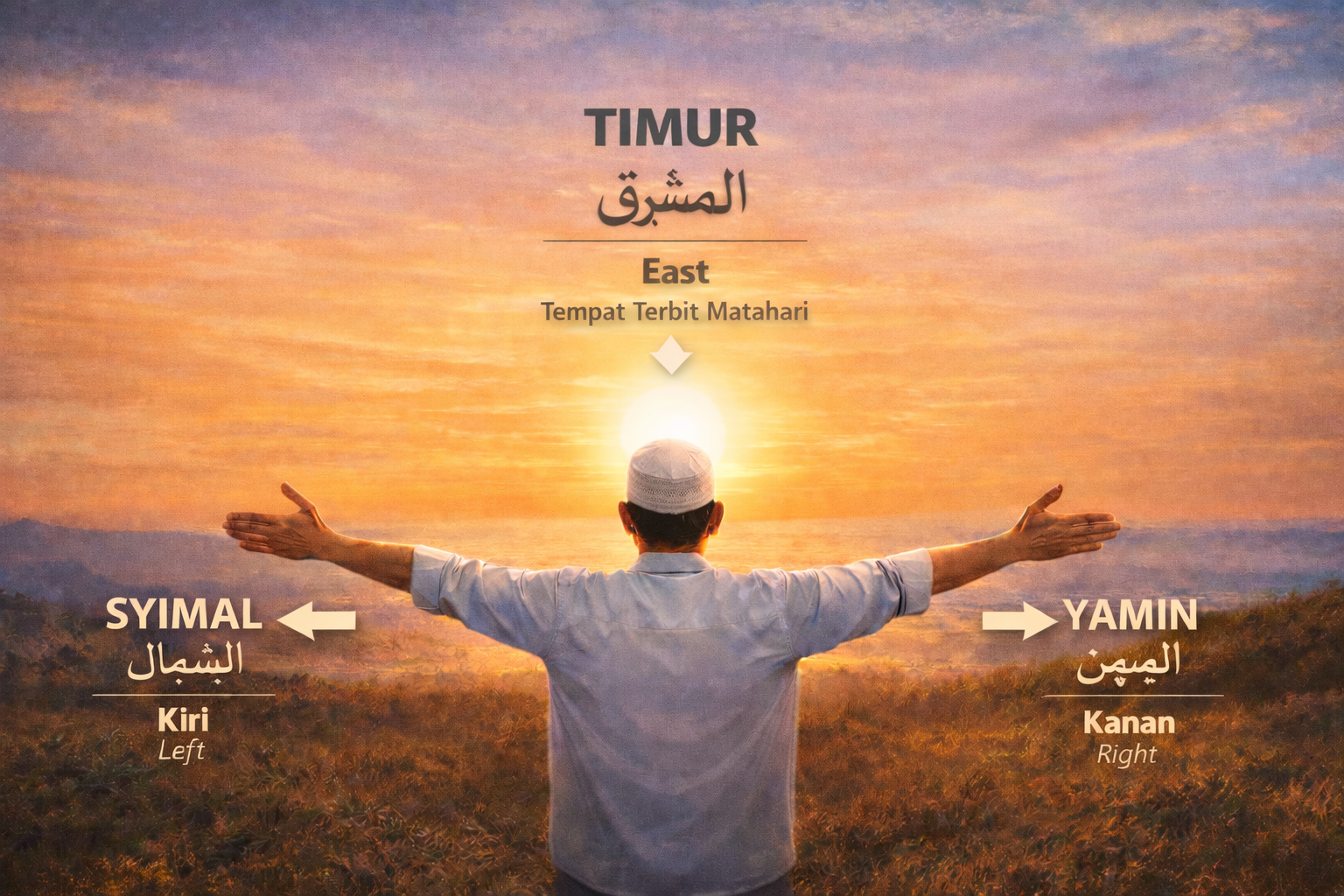
Face yourself toward the sunrise and remain there. In general, you are now facing toward the places where the sun rises. Behind you are the places where the sun sets.
Now, while your face remains forward, stretch out your left and right arms straight. In modern language, in front of you is east, behind you is west. Your right hand points toward the south and your left hand points toward the north.
In the language of the Quran, your right hand is pointing toward yamin. That is why the land to the right of Madinah is called Yemen. On your left is shimal. That is why the lands in that direction are called Sham.
Up to this point, I believe everyone already understands this basic orientation. I label it as basic orientation so that it may be referred back to easily. Can you use this method if you are in Europe or at the Cape of Good Hope in South Africa? The answer is no, because this is only the most basic method, suitable mainly within the picture of equatorial regions and the belt of sunrise.
So I hope that through this basic orientation you now understand that in front of you there are hundreds of sunrise points that change throughout the year.
Three Types of East
Before I continue, I want to provide some additional information regarding eastward direction. In navigation, we need to know at least three types of east, namely true east, grid east, and magnetic east.
Although all three use the word east, they actually refer to three different systems of directional reference.
True east is east based on the actual Earth. It is measured from true north, namely the direction of the geographic North Pole. Thus true east is the direction 90 degrees from true north. This is east from the standpoint of the Earth’s geography.
Grid east, on the other hand, is east based on grid lines on a map. In topographic maps or coordinate-based maps, there are grid lines forming squares. Grid east is the direction to the right according to that grid system. It is not necessarily the same as true east because a map grid is the result of projecting the Earth onto a flat surface.
Magnetic east is east based on the Earth’s magnetic field. It is measured from magnetic north, namely the direction shown by the compass. Because magnetic north is not the same as geographic north, magnetic east is also not the same as true east. Moreover, magnetic direction can change according to place and time.
Why Mashriq Cannot Be Equated with East
Now we are speaking about mashriq, a term that has long been casually simplified as east. In this writing, I am deliberately stopping you from accepting that equation too easily, because in my view that is where much confusion begins.
If you still wish to maintain that mashriq is east, then you must first answer one very important question. Which east? Does it mean true east, grid east, or magnetic east?
The reality is that in the context we are discussing, mashriq is not magnetic east, nor grid east, nor merely the direction to the right on a map. If one seeks the closest modern term, then mashriq is closer to true east. Even so, mashriq is still not exactly the same as the modern navigational term called true east.
Why do I say that?
Because in the tafsir of earlier scholars, mashriq is not built from compass systems, map grid lines, or the Earth’s magnetic field. Mashriq is understood based on the natural world seen by human beings, specifically the place of sunrise, the direction of the sun’s rising, and the eastern side known through the sun’s own movement.
That is why the basic meaning of mashriq held by the scholars is the direction or place of sunrise, not a modern technical direction born from surveying, geodesy, map projection, or magnetic systems.
I hope that at this stage you are becoming clearer about the meaning of mashriq. After this, when we move into the discussion of two mashriq and the plural form of mashriq, God willing, your understanding will become stronger because the foundation of orientation has already been built.
What Is Meant by Two Mashriq
Now we move to a more interesting part, namely the two mashriq. In Arabic, this expression is called mashriqayn (المشرقين). If you read the Quran, you will find it in Surah ar-Rahman 55:17 and Surah az-Zukhruf 43:38.
رَبُّ ٱلْمَشْرِقَيْنِ وَرَبُّ ٱلْمَغْرِبَيْنِ ١٧
He is the Lord who governs the two mashriq and the Lord who governs the two maghrib.
Surah ar-Rahman 55:17
حَتَّىٰٓ إِذَا جَآءَنَا قَالَ يَـٰلَيْتَ بَيْنِى وَبَيْنَكَ بُعْدَ ٱلْمَشْرِقَيْنِ فَبِئْسَ ٱلْقَرِينُ ٣٨
Until when he comes to Us, he says: “If only there had been between me and you the distance between the two mashriq.” So evil is the companion.
Surah az-Zukhruf 43:38
In Malay translations, this expression is usually rendered as the Lord who controls the two east. Set aside that translation for now. We suspend the habit of language that narrows the meaning, because what is being discussed here is mashriq, not merely “east” as loosely understood in everyday speech.
Earlier, you have read from the interpretations of previous scholars that mashriqayn, or the two mashriq, refers to two places of sunrise. Some explanations also state that they are the two major extremes of the changing sunrise positions throughout the year.
Now I will explain this to you in a way that is simpler, closer, and more practical, so that what has been explained by earlier scholars can be understood clearly.
Orientation 2
For that purpose, we build another simple model which I label as Orientation 2.
To make it easier to understand, imagine that you are now at Masjid al-Haram in Makkah. Face toward the sunrise. Behind you is the direction of sunset. Then raise your right and left hands forward at shoulder level. The opening between both arms should be slightly wider than your shoulders.
Then observe the far end on your left side, starting from your left arm, extending through your left hand, until it reaches the horizon. That is the leftmost boundary of mashriq. After that, observe the far end on your right side, from your right arm to the horizon. That is the rightmost boundary of mashriq.
What does all of this mean?
When the Quran mentions mashriqayn, it means two mashriq, that is, the two primary limits of the place of sunrise. One is at the far left. The other is at the far right. These two extremes define the meaning of mashriqayn.
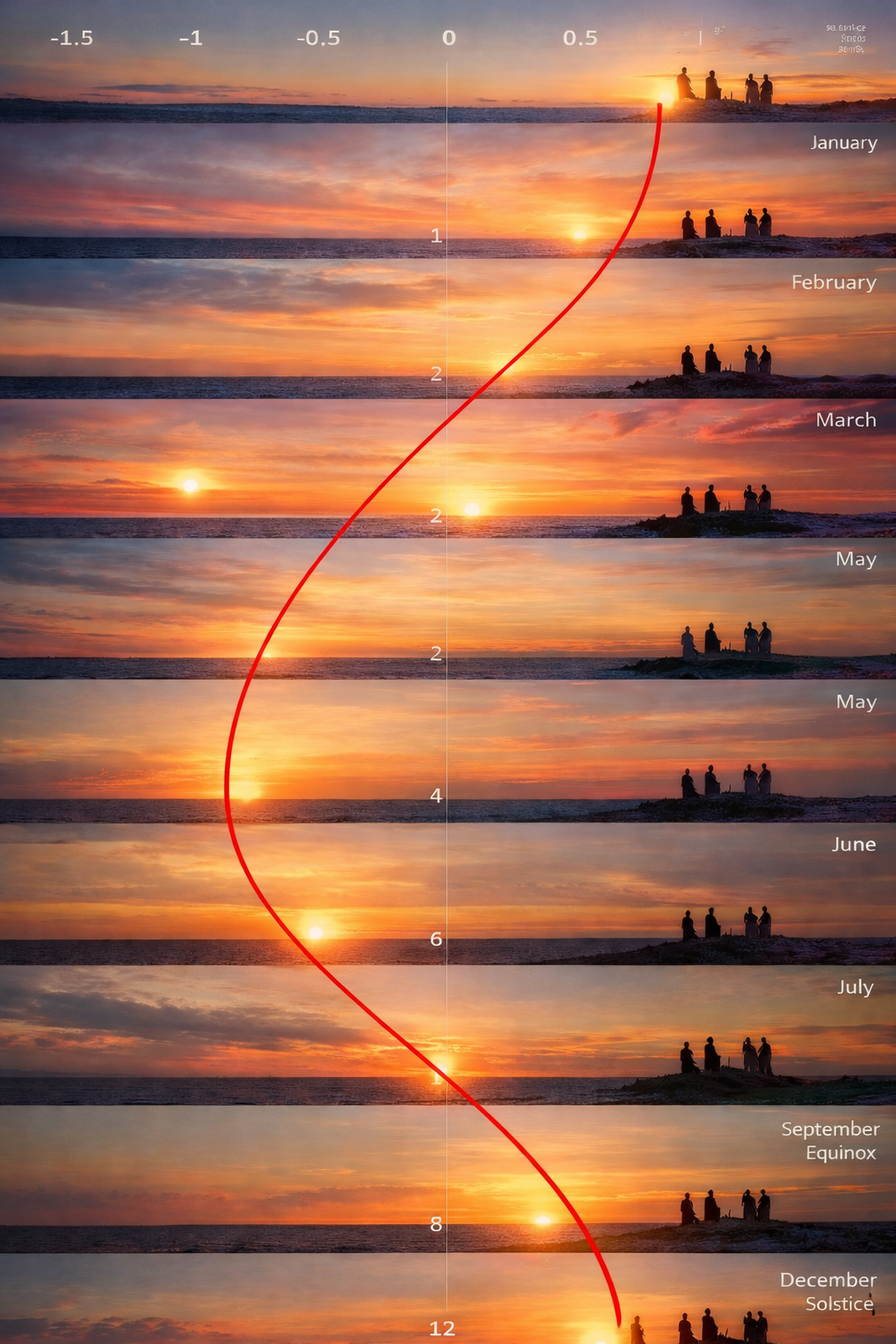
In simple terms, the sun does not rise at the same point throughout the 364 or 365 days of the year. There is a leftmost position for sunrise within the yearly cycle. There is also a rightmost position. As long as the sun continues to rise throughout the year, it does not pass beyond these two limits. The left side is the furthest left limit of sunrise. The right side is the furthest right limit. This is the meaning of mashriqayn, the two major extremes of the place of sunrise.
That is why in Surah az-Zukhruf 43:38, it is mentioned the desire to be distanced from the misleading companion as far as the distance between the two mashriq, meaning the greatest possible distance between the two extreme points of sunrise.
You are in Makkah now, are you not? Do you know that in a year there are two occasions when the phenomenon called istiwa’ a‘zam occurs, when the sun is directly above the Kaabah? At that time, people in other locations can determine the qiblah direction more precisely. However, what I want to emphasize here is something greater than that.
In reality, every place within the tropical zone, including your home in Southeast Asia, if calculated correctly, can also experience twice a year when the sun is directly overhead. This occurs as long as the location is within the tropical region, that is, within the two major limits we are discussing, or in the language we are using, between the two mashriq.
Now I will use some modern terms to help you visualize this more clearly. In this framework, the left boundary can be associated with the Tropic of Cancer, and the right boundary with the Tropic of Capricorn. The region between them is called the tropical zone.
That is why tropical countries are defined as regions within a specific path of the sun throughout the year. These areas are generally hot and receive significant rainfall. Regions outside this zone still receive sunlight, but the sun will not be directly overhead as it is in the tropical zone. In other words, those regions do not experience the sun being directly overhead twice a year as occurs within the tropics.
Thus, this is the meaning of mashriqayn as explained by earlier scholars, namely the two major limits of the place of sunrise. What I have done here is to restate it in a more structured way, together with an orientation model and some modern terminology, so that it becomes easier to understand.
Mashriqayn in the Observation of Earlier Scholars
For those who truly read the tafsir of earlier scholars, they will find that some scholars described mashriqayn as the mashriq of summer and the mashriq of winter.
Let me explain why this was stated. As mentioned earlier, the interpretations of previous scholars were largely based on observation of the natural world. Their understanding of nature was used to explain the verses of Allah according to the level of knowledge available at their time. However, time has progressed and knowledge has expanded. Therefore, any interpretation involving natural phenomena should be re-examined respectfully in light of broader knowledge today.
If you examine the background of earlier scholars, you will find that many of them were located in regions such as Iraq, Iran, Syria, and Egypt. In simple terms, they were concentrated in regions north of Makkah and Madinah. Their scholarly traditions were largely formed within the northern hemisphere.
This means their observations were based on regions with four seasons, not tropical regions. In such places, the sun is never directly overhead.
That is why they described mashriqayn in terms of summer and winter. This was based on their environment. Spring and summer move toward one extreme of sunrise, while autumn and winter move toward the opposite extreme.
This explains why they used seasonal terminology. It was not an invention detached from the Quran, but an explanation based on observation within their context.
The Plural Form of Mashriq
Next, we move to the plural form of mashriq, which in the Quran appears as al-mashāriq (المشارق). This is more accurately understood as “places of sunrise,” not simply “east.”
This part is slightly more technical. As before, we will construct another orientation model, which I label Orientation 3.
Imagine again that you extend both your arms. Now divide the space between them into six horizontal sections. Three on the left and three on the right.
Then arrange their movement in sequence from 1 to 6 and back again.
What you are seeing now is the path of mashriq across the year.
From this, twelve months are formed. The upper path represents January to June. Then it shifts and returns from July to December.
This is the basic pattern of the sun’s movement.
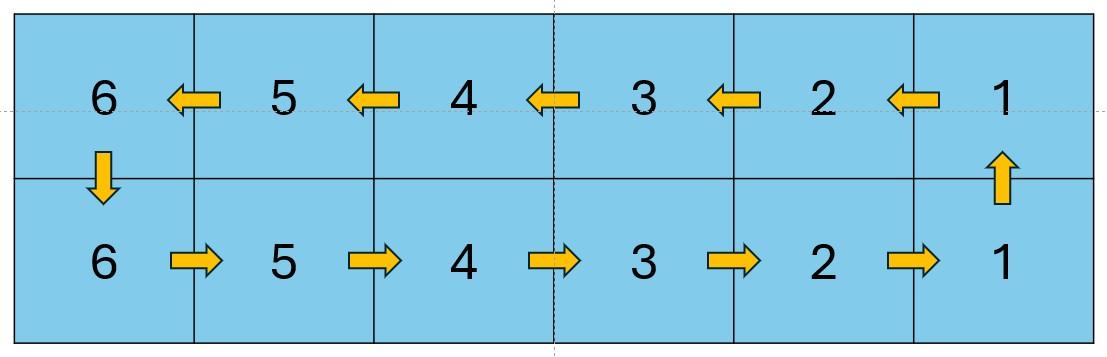
Do you know what you are actually looking at right now? That is the path of mashriq. That is the picture of how the sun moves within the domain of mashriq over the course of one year. Be patient for a moment. I know there are still parts that are not yet fully clear. Let us understand it together, slowly, so that after this it will remain in your memory for a long time, God willing.
Earlier, you formed six sections between your two arms. Then I added the direction of movement, going forward and returning back within those sections.
If you pay attention, that is where the twelve months of the solar calendar are actually formed. The path on the upper side represents the movement from January to June. After that, the movement drops to the lower side, enters July, then turns back toward the right until December. That is the basic pattern of the sun’s movement on Earth.
From this point onward, you now have a stronger foundational picture. As long as you are within the tropical region, even if you were to wake from sleep after a hundred years, it is highly likely that within just a few days you would be able to estimate which month of the solar calendar you are in.
Equinox, Solstice, and the Path of Mashriq
Now recall what was mentioned by earlier scholars regarding mashriq. They spoke of a mashriq of summer and a mashriq of winter. I have explained that such descriptions most likely arose from the observations of earlier scholars who lived within the northern hemisphere, or at least within a scholarly tradition built upon the experience of the northern horizon. That is why their explanations were highly accurate within their observational context. However, that accuracy does not necessarily mean that the entire picture of the Earth has been fully encompassed, especially when we take into account the perspective of the southern hemisphere.
Now I want to bring you to observe the movement of mashriq across a year using the Orientation 3 model. The language may be slightly technical, but if you follow it calmly, you will see that this pattern is in fact very structured.
You are certainly aware that at certain times, the day becomes longer than the night, and at other times the night becomes longer than the day. Within that yearly cycle, there are also moments when day and night are nearly equal.
In every year, there comes a point when the distribution of sunlight between the northern hemisphere and the southern hemisphere becomes more balanced. At that moment, in general, day and night appear almost equal in length. This condition is what is commonly referred to today as the equinox. For our purposes, it is sufficient to understand that the equinox is the midpoint in the sun’s annual journey.
After that midpoint, the sun continues moving in one direction until it reaches one of the extremes of mashriq. When it reaches that point, one hemisphere receives more sunlight, while the other receives less. This extreme point is what is known today as the solstice.
In simpler terms, the equinox is the midpoint, while the solstice is the endpoint.
Now bring back the Orientation 3 model that we constructed earlier. We have already formed six sections horizontally, three on the left and three on the right.
Then we arrange the movement pattern as follows:
This is a simple illustration of the path of mashriq over the course of one year.
To make it easier for everyone to understand, just assume that this journey begins around the transition from March to April, when the Earth is near a balanced state. We do not begin in January because it is not balanced. The most balanced point is at the time of the equinox.
After that, the sun moves gradually toward one side until it reaches an extreme around June. At that point, the northern hemisphere receives more sunlight and its days become longer. That is the first extreme in this cycle.
After reaching that point, the sun does not continue forward. It turns back. It returns along the same path, gradually, until it reaches the balanced region again around September. After that, it continues moving in the opposite direction until it reaches the other extreme around December. At that point, the southern hemisphere receives more sunlight and its days become longer.
After reaching that southern extreme, the sun turns back once again, then returns toward the balanced region around March. At that point, one full annual cycle is completed.
That is why, if we view mashriq not merely as “east,” but as the changing places of sunrise throughout the year, we will begin to understand that the sun actually has an annual rising path. There are times when it moves in one direction, times when it reaches an extreme, times when it turns back, and times when it returns to the balanced point.
Therefore, when some earlier scholars referred to a mashriq of summer and a mashriq of winter, we can understand that they were pointing to the two major extremes in the sun’s annual path. The difference today is that, with our understanding of the Earth in terms of the northern and southern hemispheres, we are able to see the picture more broadly. We are not only looking at one extreme, but at the entire cycle of movement and return.
Thus, al-mashāriq should no longer be imagined as a fixed eastern direction, as if the sun rises from the same point throughout the year. It is more accurately understood as the many places of sunrise that change across a full annual cycle. From there, we begin to see that the plural form carries a meaning that is precise, meaningful, and far greater than a simple translation.
Four Quarters of the Solar Cycle
Since we have reached this stage, then on this occasion it is better for me to continue this discussion in greater depth, up to the level of the number of days in each month, so that you are able to calculate the calendar yourself even if technology collapses in the end times.
Now we can go a little further. After we understand that the sun has an annual rising path, moving in one direction, reaching an extreme, then turning back in the opposite direction, the next question is this:
How long does the sun remain in each of those paths?
This is where we begin to see a very interesting structure that I have learned from the Quran. The sun’s annual path does not move randomly. It moves within a structured cycle. In the Orientation 3 model that we are using, one year is divided into 12 main stages, and each stage has its own number of days.
To make it easier to understand, we return to the arrangement of sections that we formed earlier. We have already imagined six sections from right to left, then the movement turns back through the same sections. Thus, one complete annual cycle can be visualized as explained above.
If observed carefully, one year can actually be divided into four major parts.
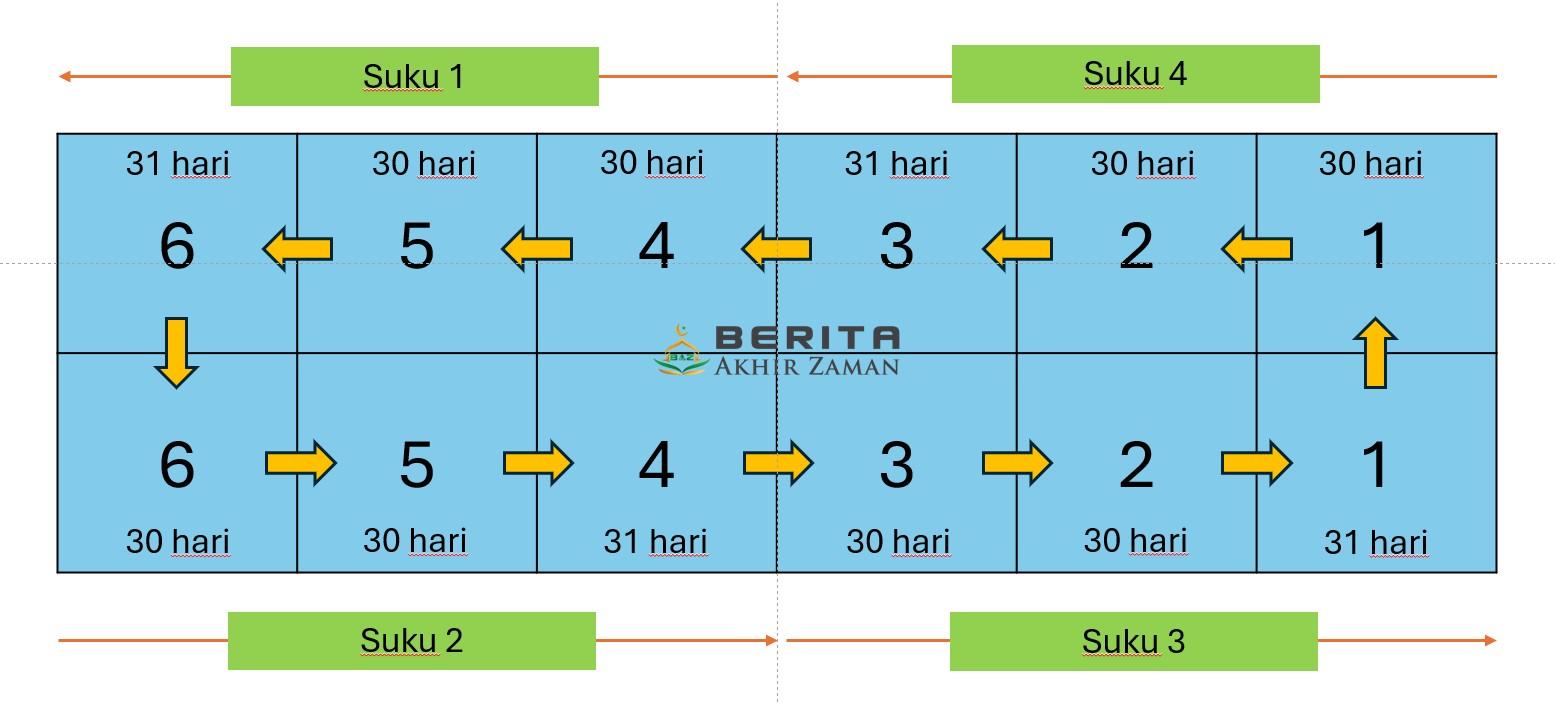
The first part, or first quarter, is the movement from the balanced region, around the equinox in early April, toward one extreme. The second part is the movement from that extreme returning to the next balanced region. The third part is the movement from that balanced region toward the other extreme. The fourth part is the movement from the second extreme returning back to the original balanced region.
Quarter 1 from the balanced region toward the first extreme:
Section 4 = 30 days
Section 5 = 30 days
Section 6 = 31 days
Total = 91 days
Quarter 2 from the first extreme turning back toward the next balanced region:
Section 6 = 30 days
Section 5 = 30 days
Section 4 = 31 days
Total = 91 days
Quarter 3 from that balanced region toward the other extreme:
Section 3 = 30 days
Section 2 = 30 days
Section 1 = 31 days
Total = 91 days
Quarter 4 from the second extreme turning back toward the original balanced region:
Section 1 = 30 days
Section 2 = 30 days
Section 3 = 31 days
Total = 91 days
Total for one year = 364 days.
This is where we begin to see a major pattern, that one year is actually built from four equal quarters, because 91 days multiplied by four produces 364 days. This shows that the sun’s annual cycle can be divided in a very orderly way.
With this division, we can also observe another important point.
Quarter 1: the northern hemisphere moves toward receiving more sunlight.
Quarter 2: the northern hemisphere begins to lose sunlight again.
Quarter 3: the southern hemisphere moves toward receiving more sunlight.
Quarter 4: the southern hemisphere begins to lose sunlight again.
From Two Mashriq to Many Mashāriq
After we have seen how seasonal changes occur as the sun moves across those sections, we can now return to the term under discussion. The entire annual movement of the sun actually has two major boundaries, namely the two extremes of its points of sunrise, one at the upper side and one at the lower side. This is what helps us understand the meaning of mashriqayn, that is, the two major limits of the place of sunrise within a year. Between these two limits exist many points of sunrise that the sun passes through along its cycle.
From here, we begin to see that mashriq is not merely “east” in the general sense of direction, but is more accurately understood as the place of sunrise. As for mashāriq, it refers to the many places of sunrise that lie between those two boundaries.
Now we return to the core meaning of the term under discussion. All the explanations about the movement of the sun, the changes of seasons, the differences between hemispheres, as well as the forward and returning movement throughout the year, are not the final objective. All of that is only a path that allows us to see a greater reality, namely that the sun does not rise from the same point throughout the year.
This is where the meaning of mashriq must be corrected in the mind of the reader. Mashriq is not merely “east” in the general sense of direction, but is more accurately understood as the place of sunrise. When that place of sunrise changes throughout the year, then its plural form, mashāriq, becomes precise, meaning the many places of sunrise.
Thus, the entire discussion above is leading us to a very important conclusion. The term mashriq is not sufficient if it is understood only as “east,” and the term mashāriq is not sufficient if it is imagined merely as many “easts.” What is more accurate is to understand that the Quran is referring to the reality of multiple places of sunrise across a full annual cycle. It is there that the meaning of the term becomes alive, precise, and far greater than the simple translation that we are accustomed to hearing.
Conclusion
I believe it is sufficient up to this stage, and at this point I am already able to help you arrive at a conclusion.
After we have seen how the sun moves throughout the year and how that movement forms the changes of seasons, we can now return to the term under discussion.
The annual path of the sun has two major boundaries, one at the upper side and one at the lower side. This is the foundation for understanding mashriqayn.
However, the sun does not rise only at those two boundaries, because between them there are many points of sunrise throughout the yearly cycle.
From here, we begin to understand that mashriq is the place of sunrise, while mashāriq are the many places of sunrise.
Therefore, translating it simply as “east” is no longer sufficient to explain the true meaning of mashriq.
If you have truly understood the explanations of the earlier scholars, and also understood what I have explained through all the orientation models that I have presented, then by now, God willing, you should already be able to state with confidence the true meaning of this statement:
“Imam Mahdi comes from the mashriq, and the Black Banners come from the mashriq.”
“Imam Mahdi comes from the mashriq, and the Black Banners come from the mashriq.”
Research Support
This writing is an exclusive BAZ research article published on the official site:
https://beritaakhirzaman.com
If you wish to continue supporting in-depth research, linguistic analysis and historical exploration not published anywhere else, you may contribute voluntary sponsorship through the following link:
Click here to support us
Reader support is managed through member accounts on the BAZ website.
Member login: https://member.beritaakhirzaman.com/login
Free registration: https://member.beritaakhirzaman.com/register
Reply to: